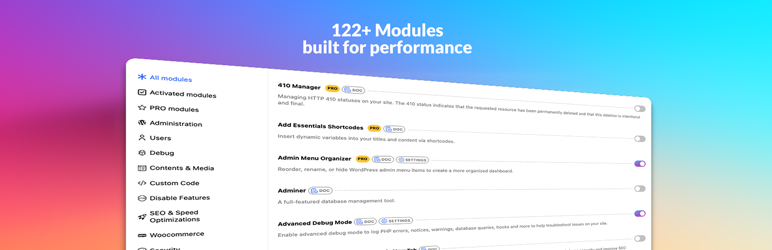
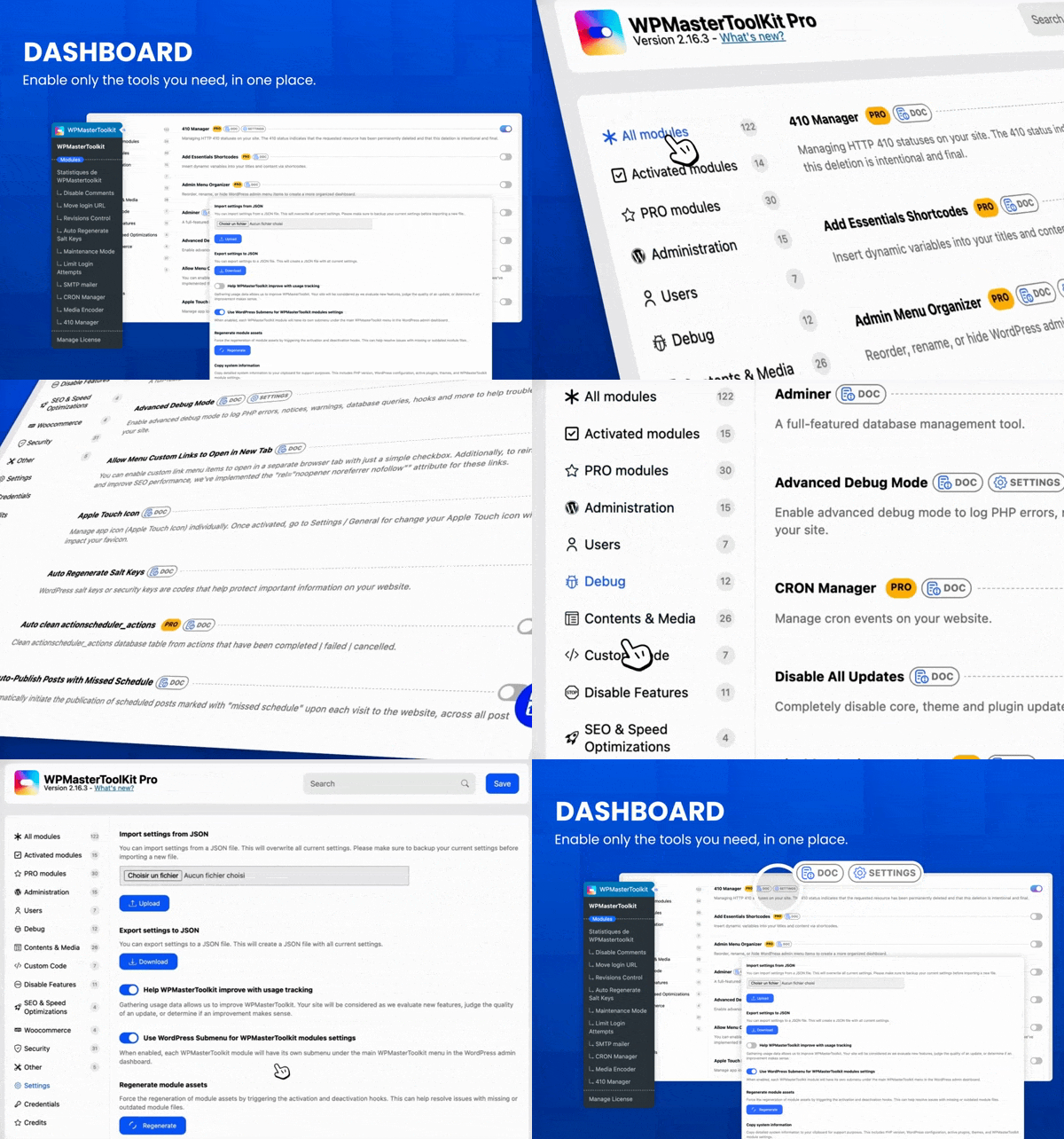
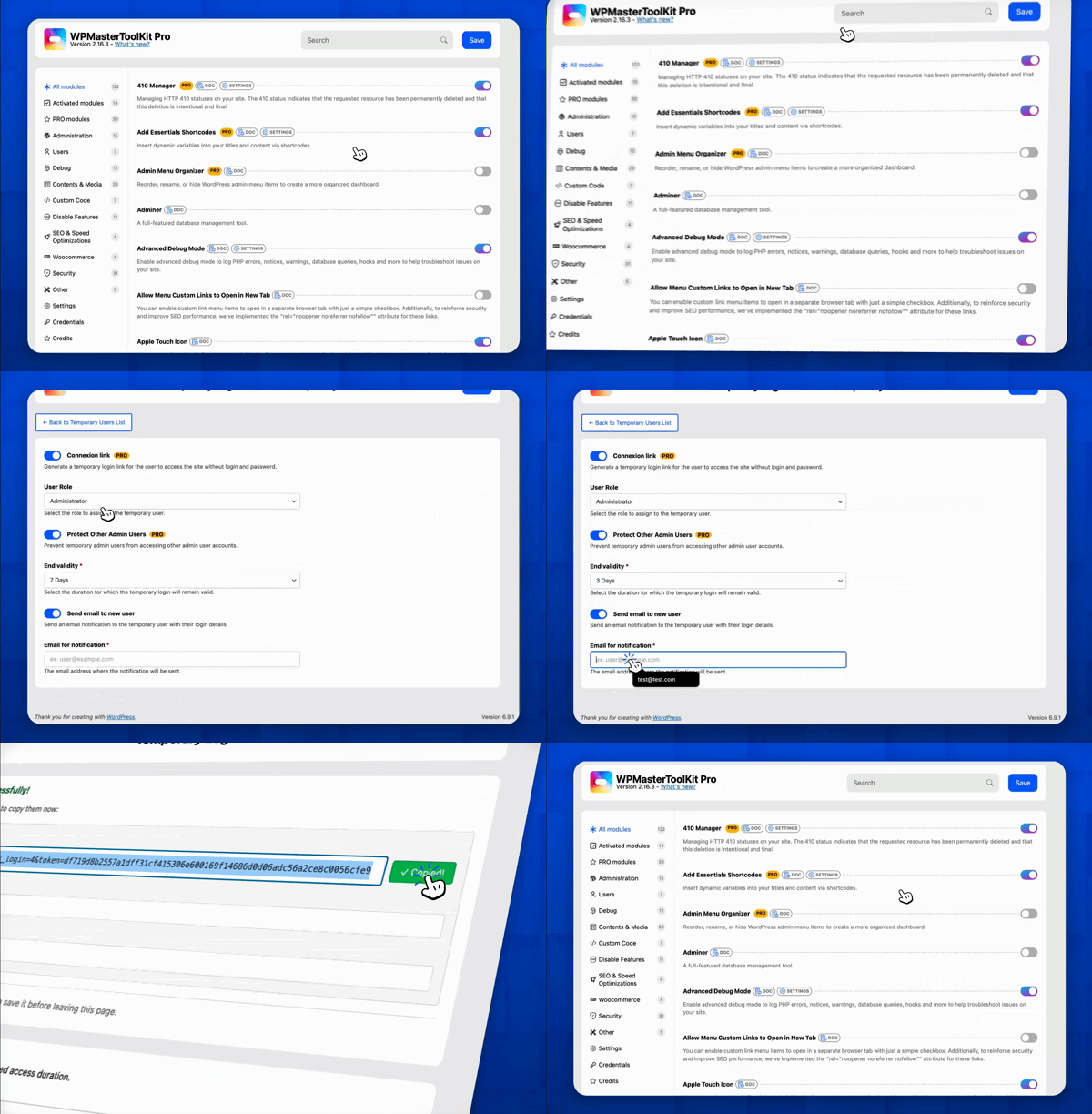
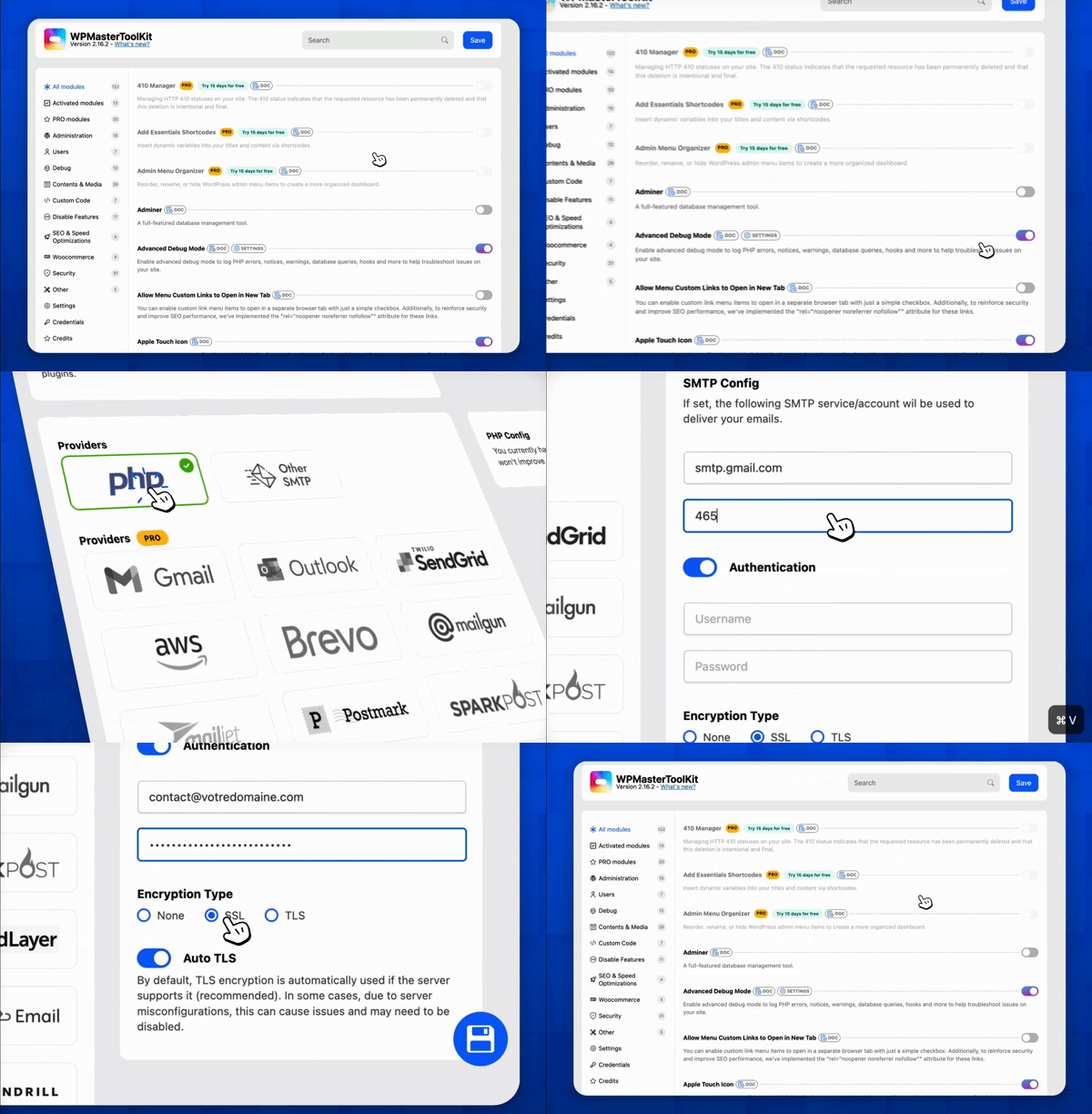
WPMasterToolKit is a plugin that allows you to add a lot of features to your WordPress site.
WPMasterToolKit is an all-in-one WordPress plugin that replaces dozens of separate plugins with 100+ modular tools for security, performance, administration, media and development.
Activate only what you need and manage everything from one place. Built for site owners, freelancers, developers and agencies.
98 free modules, plus 37 advanced modules and additional features with WPMasterToolKit Pro.
WPMasterToolKit does not connect every website to external services by default. Some optional modules can communicate with third-party providers only when you enable and configure them, for example SMTP and email providers, social login services, geolocation databases, vulnerability data sources, analytics platforms or AI services. The data transmitted depends on the selected module and provider. Review the module settings and the provider’s terms and privacy policy before enabling an integration.
What is WPMasterToolKit?
WPMasterToolKit is a modular all-in-one WordPress plugin for site administration, security, performance, media, email delivery and development. It brings together 100+ tools in one dashboard, including code snippets, content duplication, SMTP, WebP conversion, login protection, redirects and database utilities.
Is WPMasterToolKit free?
Yes. The free version includes 98 modules for WordPress administration, security, performance, media management and development. WPMasterToolKit Pro adds 37 advanced modules and premium features such as two-factor authentication, vulnerability scanning, AVIF conversion, advanced SMTP providers, White Label and Pixel Tag Manager.
Do I have to enable every module?
No. WPMasterToolKit is modular, so you can enable only the features you need. Disabled modules do not load their feature logic on your website. This also helps prevent conflicts caused by activating overlapping tools.
Will WPMasterToolKit slow down my website?
WPMasterToolKit is designed to load modules only when they are enabled. Actual performance depends on your hosting, theme, other plugins and the modules you select. Several tools can also help reduce frontend work, including Heartbeat Control, WebP image conversion and options to disable emojis, cart fragments, Dashicons or jQuery Migrate when they are not needed.
Can WPMasterToolKit improve WordPress SEO?
WPMasterToolKit is not a replacement for a dedicated WordPress SEO plugin, but it includes technical tools that can support SEO and website performance. These include WebP and AVIF image optimization, robots.txt management, redirect management, media metadata tools, local Google Fonts, external link attributes and control over the default WordPress sitemap.
Can WPMasterToolKit replace other WordPress plugins?
It can replace multiple single-purpose plugins when its modules cover the features you use. Common examples include plugins for duplicate posts, SMTP email, code snippets, WebP conversion, login URL changes, login attempt limits, redirects, maintenance mode, SVG uploads and child theme generation. Test changes on a staging site and avoid running two plugins that provide the same feature.
Can WPMasterToolKit replace a WordPress security plugin?
WPMasterToolKit includes security hardening tools such as Limit Login Attempts, Move Login URL, strong password enforcement, user enumeration protection, XML-RPC control, security headers and file access restrictions. These features can replace several security tweaks, but they are not a guarantee against every threat and may not replace a dedicated firewall, malware scanner, backup service or security monitoring platform for high-risk websites.
How do I change or hide the WordPress login URL?
Enable the Move Login URL module and choose a custom login path. The module changes access to the default WordPress login URL to reduce automated login traffic. WPMasterToolKit Pro can additionally block unauthenticated access to /wp-admin with a server-side 403 response.
How does the local CAPTCHA work?
Enable Captcha on login form and select the native WordPress login, lost-password and registration forms to protect. It generates addition questions locally, without contacting an external provider or requiring an image library. Arithmetic adds friction for basic bots; it is not reliable human detection and should supplement Limit Login Attempts and two-factor authentication. CAPTCHA errors have separate throttling and do not count as incorrect credentials.
Choose the protection mode using the radio options in the module settings. Always require is available in the free edition and shows a question on every protected form. Adaptive is available only with WPMasterToolKit Pro and is the default in Pro when no mode has been saved. Its time windows, failed-login thresholds, request limits and form-timing options appear only when Adaptive is selected. Switching to Always require hides those controls but preserves their saved values. Free installations always use Always require, including when a previously saved mode was Adaptive.
In Adaptive mode, low-risk visitors see no arithmetic question but submit a browser-bound, single-use form token. The server rechecks activity on submission and before two-factor code sending or final login. If risk increases, the visitor must solve a question. Successful solves authorize only their bounded flow, not a persistent trusted-browser exemption.
Editable defaults require a challenge after three authentication failures per browser or five per IP, ten login submissions, three recovery requests, three registration requests, or three two-factor code requests within a five-minute observation window. Request thresholds apply to the attempt reaching the limit; failure thresholds apply to subsequent attempts. A challenge-required period lasts fifteen minutes and is not extended by each retry. Browser and IP activity are tracked separately, without account-wide penalties. These adaptive thresholds do not replace hard rate limits or credential lockouts, and a solved CAPTCHA cannot bypass those limits.
Optional form timing supplements existing server suspicion: submissions under 1.5 seconds can require a question once at least half a relevant server threshold is reached, with a minimum of two events. Fast submission alone, absent timing, autofill, pasted passwords and missing JavaScript are not independent reasons to require CAPTCHA. Only a bounded elapsed-time hint is sent; typing, pointer movement, fingerprints, passwords and timing history are not collected or retained. Timing can be disabled in settings.
The module requires first-party cookies and database write access. Open its settings page after activation or upgrade to initialize storage and invalidate older policy state before signing out. Form tokens and challenges expire after ten minutes and allow one attempt. Two-factor continuations allow up to three code-send attempts and one final login within fifteen minutes; low-risk continuations are reassessed and revoked if a question becomes necessary. Refreshing or cancelling the two-factor flow invalidates its continuation. Native submissions work without JavaScript and return a visible challenge if risk escalates; this does not add no-JavaScript support to the existing two-factor modal.
The binding cookie is HttpOnly, uses SameSite=Lax and Secure on HTTPS, and lasts for the browser session. Expiring state contains keyed browser, IP and entered-identifier hashes, not raw identifiers or passwords. Hard defaults allow 60 state issuances and 20 rejected CAPTCHA validations per IP per five-minute fixed window, with additional validation/browser/site ceilings. Shared networks and reverse proxies can increase challenges or throttling; limits use REMOTE_ADDR, not forwarded headers. Expired records are removed in bounded batches during activity/issuance and hourly cleanup while the module is active. Plugin deactivation removes ephemeral storage; merely toggling the module off stops enforcement but does not immediately erase its state or settings.
Exclude native login routes, including renamed routes, and CAPTCHA AJAX responses from page/CDN caches. Response headers cannot prevent a cache from serving a stale page before WordPress runs. Native-form protection preserves OAuth callbacks, temporary magic links, user switching and application-password/API authentication; it does not cover WooCommerce or membership/custom forms, multisite signup, shared-password gates or password-reset completion. Individual multisite sites have separate storage.
If storage fails, protected submissions are rejected rather than silently bypassing CAPTCHA. Keep an authenticated administrator session during configuration. For recovery, disable the module from that session or temporarily define WPMASTERTOOLKIT_SAFE_MODE as true in the site’s server-side configuration; safe mode disables all WPMasterToolKit modules. Restore normal operation after resolving the storage issue. Do not enable overlapping CAPTCHA plugins without testing the combined forms.
How do I disable XML-RPC in WordPress?
Enable the Disable XML-RPC module from the WPMasterToolKit dashboard. Disabling XML-RPC can reduce exposure to attacks that target this legacy interface, but first confirm that your mobile app, remote publishing service or integration does not depend on it.
Can I disable the WordPress REST API for logged-out visitors?
Yes. The Disable REST API module restricts REST API access for unauthenticated visitors and removes related discovery links. Because themes, plugins and external applications may rely on the REST API, test this setting before using it on a production website.
Can I convert WordPress images to WebP or AVIF?
Yes. The Media Encoder module converts images locally on your WordPress server instead of sending them to an external optimization service. The free version supports automatic WebP conversion, while WPMasterToolKit Pro adds AVIF conversion on compatible servers running PHP 8.1 or later.
How do I configure WordPress SMTP email?
Enable SMTP Mailer, enter the sender details and SMTP credentials, then send a test email from the module settings. The free version supports PHP mail and generic SMTP. WPMasterToolKit Pro adds integrations for 19+ providers, including Gmail, Outlook, SendGrid, AWS SES, Brevo, Mailgun, Mailjet, Postmark and Resend.
Does WPMasterToolKit work with WooCommerce?
WPMasterToolKit includes WooCommerce-specific tools such as disabling cart fragments for logged-out visitors, removing the logout confirmation and customizing the My Account menu. It also uses standard WordPress and WooCommerce APIs where applicable. As with any plugin stack, test checkout, account and caching behavior on a staging site after enabling performance or WooCommerce modules.
Can I disable the Gutenberg block editor?
Yes. The Disable Gutenberg module can restore the classic editor for selected post types or disable the block editor more broadly. This gives you control over where Gutenberg is used without modifying your theme.
Can I duplicate WordPress posts, pages and custom post types?
Yes. Content Duplication adds one-click duplication for posts, pages and custom post types. It also copies associated taxonomy terms and post metadata, which is useful for reusing page structures, product content and custom content templates.
Can I add WordPress code snippets without editing functions.php?
Yes. Code Snippets lets you manage reusable PHP code from the WordPress dashboard without editing your theme’s functions.php file. Snippets can also contain CSS inside <style> tags or JavaScript inside <script> tags. Incorrect custom code can break a website, so validate snippets and test them on staging first.
Can I manage the WordPress database without phpMyAdmin?
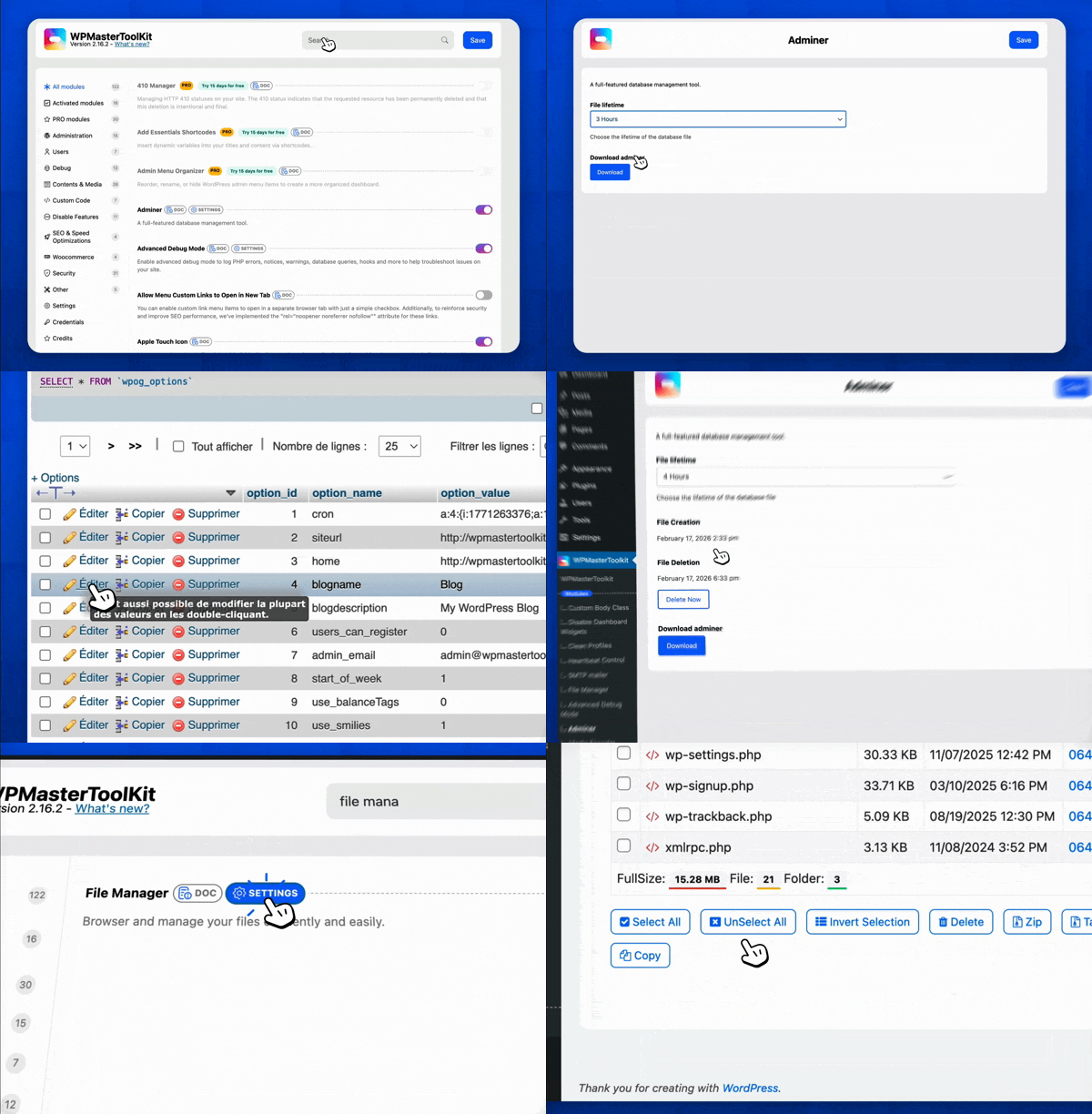
Yes. The Adminer module provides a database management interface inside WordPress for browsing tables and running database operations. Database changes can be destructive, so restrict access to trusted administrators and create a complete backup before editing data or running SQL queries.
Can I create a WordPress child theme?
Yes. Child Theme Generator creates a child theme from the active theme directly in the WordPress dashboard. After generation, you can disable the module because the child theme continues to work independently.
Can I upload SVG files to WordPress?
Yes. The SVG Upload module enables SVG media uploads and validates SVG file content. Because SVG is an XML-based format that can contain active content, only trusted users should be allowed to upload files.
Does WPMasterToolKit include a WordPress redirect manager?
Yes. The free Redirect Manager supports WordPress/PHP redirects. WPMasterToolKit Pro adds Apache and Nginx redirect engines, redirect logs and CSV import/export. Redirects should be tested carefully to avoid loops and inaccessible pages.
Does WPMasterToolKit work with multisite installations?
WPMasterToolKit includes multisite-aware behavior in several modules, but support can vary by feature. Test each required module on a staging network before network activation, especially modules that modify files, login URLs, media settings or database content.
How long does Activity Log keep its history?
Activity Log automatically deletes history older than one calendar month in Free, including existing installations when the module is enabled. This retention period cannot be changed in Free. Pro keeps its configurable retention policy and defaults to three calendar months; Pro users can select Keep all data to retain their entire history. Saved Pro retention preferences are preserved while Pro is unavailable, but the fixed one-month Free policy applies until Pro is active again. The first cleanup is scheduled 24 hours after initialization; subsequent runs are daily and depend on WordPress cron. Back up existing archives before upgrading or switching to Free if older history must be preserved.
Pro retention supports days, months and years. Cleanup deletes whole daily log files dated before the UTC cutoff day, preserving that day’s files and any files with uncertain or newer records. Purge Old Data uses the fixed one-month policy in Free or the saved policy in Pro and permanently deletes eligible files; unsaved form changes do not affect it. Disabling the module, deactivating the plugin or uninstalling it stops scheduled cleanup without erasing saved history.
Can I exclude activity from the Activity Log?
Pro supports exclusions by users, actor roles, IP addresses and post types. Roles and supported post types are searched dynamically; IP addresses are entered locally without AJAX. Any matching exclusion skips new events without changing existing history. Free preserves saved exclusions but does not enforce them.
IP exclusions accept individual IPv4/IPv6 addresses and CIDR ranges. Matching uses only the server connection address (REMOTE_ADDR), not proxy forwarding headers; behind a proxy this may be the proxy’s address. IP exclusions do not apply to CLI or cron execution. Post-type exclusions cover direct core content and attachment events only; comments, menus, taxonomy and WooCommerce events remain logged according to their event settings.
Is WPMasterToolKit compatible with Elementor, Divi and other page builders?
WPMasterToolKit uses standard WordPress hooks and is designed to work alongside popular themes and page builders. Tools such as content duplication, custom body classes and custom frontend CSS can complement page-builder workflows. Compatibility can still depend on the specific modules and third-party extensions enabled, so test important pages after configuration changes.
How often is WPMasterToolKit updated?
WPMasterToolKit is regularly updated with new modules, improvements, security hardening, bug fixes and compatibility changes. Review the changelog before updating production websites and use a staging environment for business-critical sites.
How can I report a security vulnerability?
Please report security issues privately through the Patchstack Vulnerability Disclosure Program. The Patchstack team helps validate, triage and coordinate security reports. Do not publish vulnerability details before a fix is available. Report a security vulnerability.