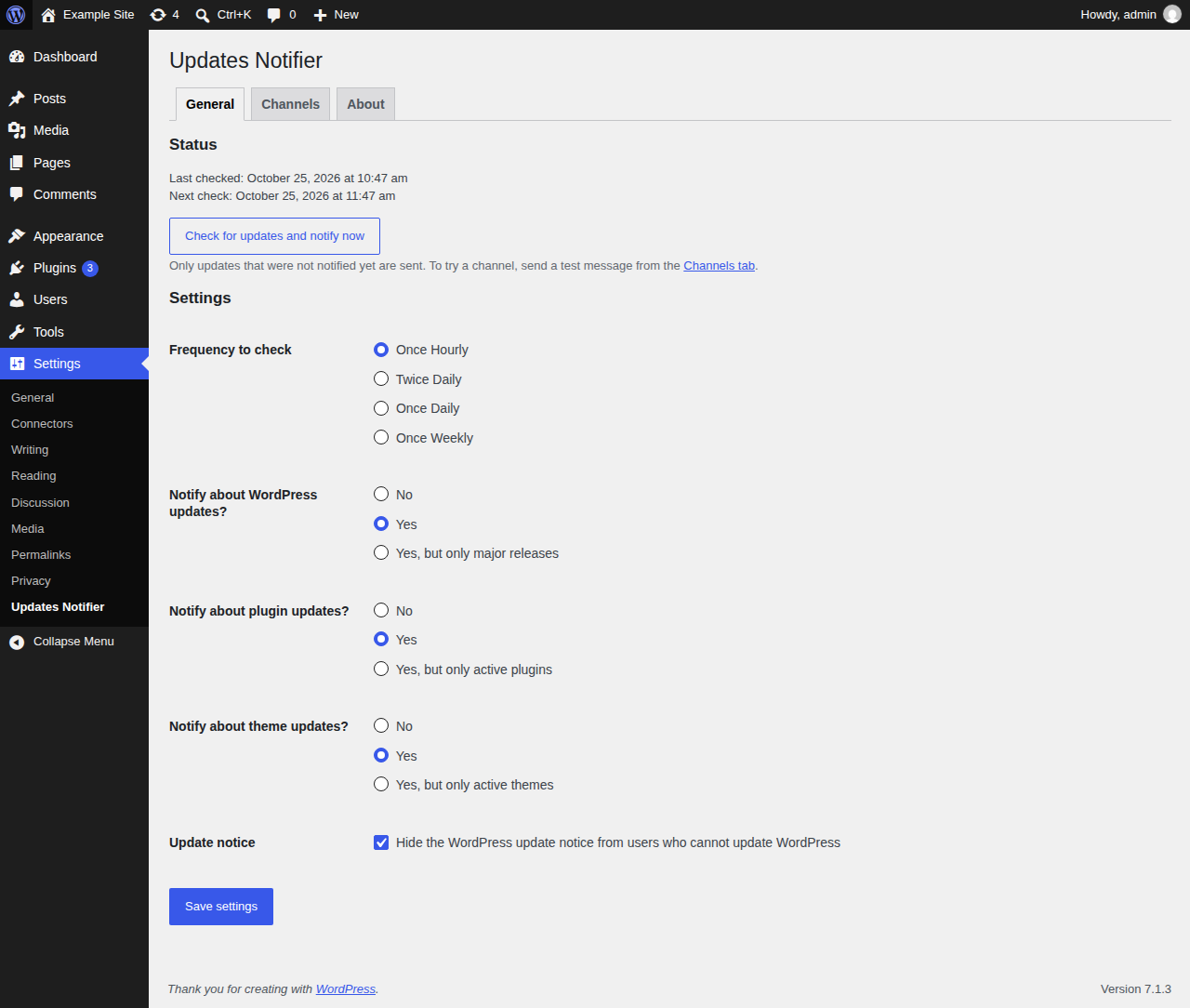
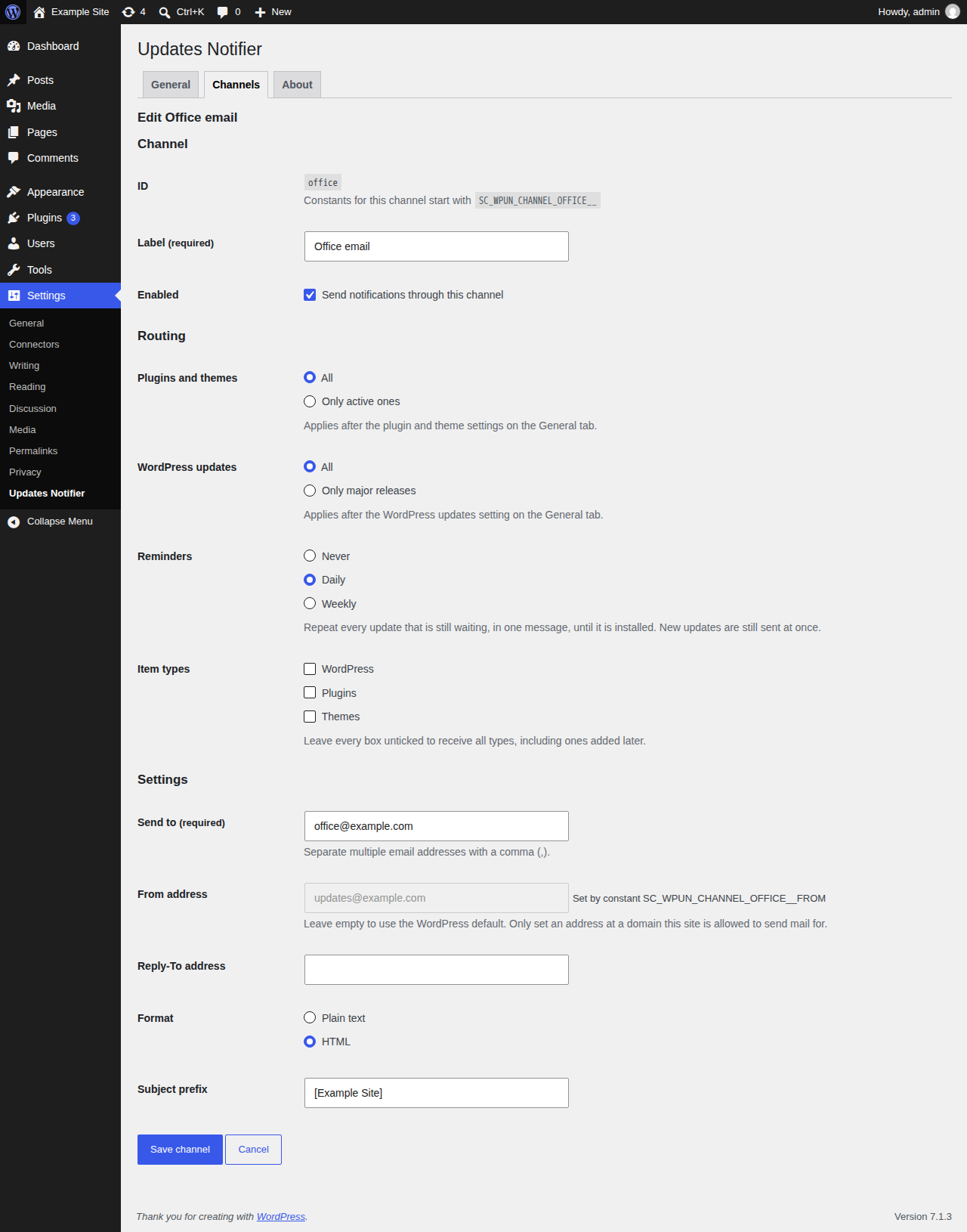
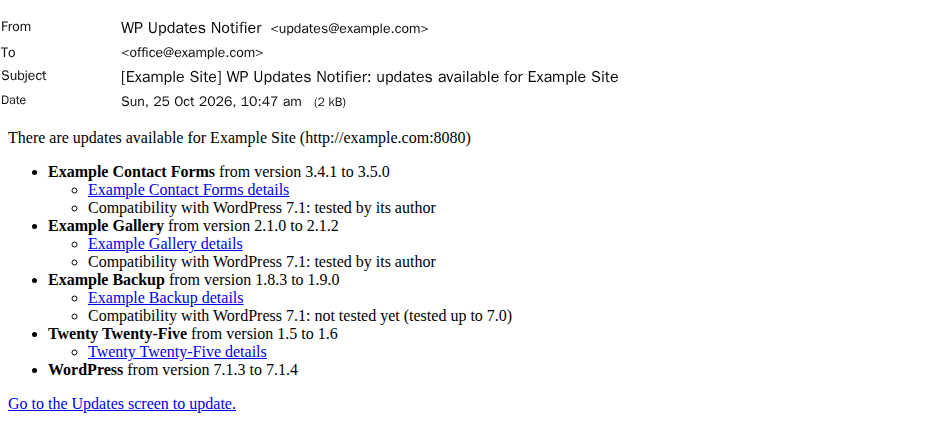
Sends email to notify you if there are any updates for your WordPress site. Can notify about core, plugin and theme updates.
WP Updates Notifier checks your site on a schedule and emails you when WordPress core, a plugin or a theme has an update waiting, so you know without logging in. It is made for sites you rarely visit and for sites you look after for clients.
Each new version is reported once, not on every check. Version 2.0.0 is a ground-up rewrite of a plugin first released in 2011: the same simple promise, with the testing, accessibility and security work a plugin on this many sites deserves.
WordPress 6.7 or newer and PHP 7.4 or newer, on a single site. Version 2.0.0 does not support multisite networks.
Why did I not get an email about an update?
Check these in turn:
- Was it already reported? Each channel is told about each version once. See How notifications work.
- Is the channel on? On the Channels tab, Enabled must say On.
- Does a setting leave it out? On the General tab, the setting for that kind of update must not be No, and if it is limited to active plugins or themes, the plugin or theme must be active. Check the channel’s Routing column too.
- Did the send fail? Last delivery shows Failed and the reason.
- Has the check run? Last checked on the General tab says when. If it is old, see the next entry.
- Is the data old? See Why is the update data hours old?.
Emails only arrive after someone visits the site
The schedule is run by WP-Cron. WP-Cron is not a real clock. WordPress only looks for due tasks when a page is requested, so on a site that few people visit, a check due at 03:00 can wait until someone arrives at 09:00. A forum user put it as “I only receive emails after someone has logged in”.
To fix it, run WP-Cron from the server’s own clock. See How do I run the check from a system cron?.
How do I run the check from a system cron?
There are two ways. Use the first unless you have a reason not to.
Request wp-cron.php
Stop WordPress starting WP-Cron on page loads by adding this to wp-config.php:
define( 'DISABLE_WP_CRON', true );
Then have the server request wp-cron.php on a regular schedule, for example every 15 minutes:
*/15 * * * * curl -fsS https://example.com/wp-cron.php > /dev/null
WP-Cron then runs the plugin’s check at the Frequency to check you chose, and WordPress’s own update tasks too.
Fire the check yourself
The plugin’s check can also be started from code with the sc_wpun_run_check action. For example, with WP-CLI:
*/30 * * * * cd /path/to/site && wp eval "do_action( 'sc_wpun_run_check' );"
This runs the same check as the schedule, and anything already reported is not sent again. It does not move the WP-Cron schedule, so Next check on the General tab does not change. If you rely on this alone, the time of your cron entry is the schedule.
Things to know:
- The plugin does not lock checks against each other. If this overlaps another run, the same update can be sent twice. This is a known trade-off, and rare. See How notifications work.
- A check started this way is not a WP-Cron run, so WordPress lets plugin and theme data get up to 12 hours old before it refreshes it. A check started by
wp-cron.php allows 2 hours. See Why is the update data hours old?.
Why is the update data hours old?
On every check the plugin asks WordPress to refresh what it knows about updates. WordPress asks api.wordpress.org, but it does not do so every time. It skips the request when it has asked recently:
- The schedule, or
wp-cron.php – Core updates: 1 minute; Plugins and themes: 2 hours
- Check for updates and notify now, or
wp eval – Core updates: 1 minute; Plugins and themes: 12 hours
So a scheduled check can see plugin and theme data up to two hours old, and a manual check up to twelve. WordPress also asks again early if the plugins or themes you have installed, or their versions, have changed.
To get current data before a manual check, open Dashboard → Updates in WordPress first. That page refreshes the data if it is more than a minute old.
Note: These limits belong to WordPress, not to this plugin. They keep your site from calling api.wordpress.org too often.
Why does the email not arrive?
Send test on the Channels tab says “Test message sent” when WordPress has handed the email to your mail system. That does not mean the message was delivered. Check the spam folder first, then look at how your site sends mail.
- The From address. With From address empty, the email uses the WordPress default, which is
wordpress@ followed by your site’s domain. If you set one, it must be at a domain your server is allowed to send mail for. Mail that claims to come from a domain the server has no permission for is often rejected or sent to spam.
- SPF, DKIM and DMARC. These DNS records tell mail providers which servers may send for your domain. If your domain publishes a strict DMARC policy and the From address does not line up with the server that sends, providers can reject the message. Ask your host or mail provider for the right records.
- The server’s mail. Many hosts block or throttle the basic mail function WordPress uses. Install an SMTP plugin, or a plugin for a mail service, so WordPress sends through an authenticated mail server. Then send a test again.
- Upgraded from 1.x? Versions before 2.0.0 sent from the administration email address unless you set another. If your From address was that same address, the upgrade cleared it, so mail goes from the WordPress default. Set From address if your mail setup needs one.
If WordPress itself fails to send, the reason appears in the notice after the test and under Last delivery.
Why does a message show the wrong address?
The address in a message is your site’s home address, the Site Address (URL) in Settings → General. The link to the Dashboard → Updates screen is built from the WordPress Address (URL).
Both can be wrong if wp-config.php sets WP_HOME or WP_SITEURL from the request, for example from $_SERVER['HTTP_HOST']. The check then runs in a request from a system cron or a visitor, and the address follows whichever host that request used. Set WP_HOME and WP_SITEURL to fixed addresses, or remove them and use the settings in Settings → General.
Why did Slack notifications stop?
WP Updates Notifier 2.0.0 does not send Slack notifications, and your Slack settings are kept. If a Slack channel was switched on, the plugin tells you once by email, shows a notice on its settings page that you can dismiss, and adds an item to Tools → Site Health. The notice and the item stay while a Slack channel is switched on.
Will I be told about every version?
Each channel is told about each new version once. If you don’t install it, nothing more is sent unless you switch on daily or weekly reminders for that channel. See How notifications work.
Does it work on multisite?
Not yet. Version 2.0.0 supports single sites only.
How do I send WordPress’s automatic update emails to another address?
Version 2.0.0 leaves WordPress’s own automatic update emails alone, so they go to the admin email under Settings > General. Change that address, or set the recipient with the auto_core_update_email filter:
add_filter( 'auto_core_update_email', function ( $email ) { $email['to'] = 'ops@example.org'; return $email; } );
The auto_plugin_theme_update_email filter does the same for plugin and theme automatic updates.
How do I report a security problem?
Please don’t post it in the support forum or in a public GitHub issue. Report it privately through GitHub: on the repository’s Security tab, choose “Report a vulnerability”. The security policy has the details, and an email address if you can’t use GitHub.