WordPress websites are frequently targeted by brute force attacks, credential stuffing attacks, phishing attempts, and unauthorized login attempts. Passwords alone are no longer sufficient to protect administrator accounts, customer accounts, and sensitive website data. Which is exactly why 2FA has become essential.
What’s New in 6.6.1
Minor security fixes.
Custom Login URL (Premium) — change wp-login.php to a custom slug, with a built-in check so a bad slug can’t lock you out.
Country/Region (Geo) Blocking (Premium) — block or allow logins by visitor country.
Slack Alerts (Premium) — webhook notifications on successful/failed logins, IP blocks, geo-blocked visitors, and 2FA resets.
Automatic brute-force lockout — blocks an IP after too many failed login attempts in a configurable window, for a configurable duration.
CIDR notation for IP Range Blocking — block whole network ranges (e.g. 192.168.1.0/24), alongside the existing start-end format.
Gravity Forms registration integration, alongside WooCommerce, User Registration, Ultimate Member, and Registration Magic.
Multiple security hardening fixes: corrected session-expiry and clock-drift handling, added missing rate limiting on self-service account recovery, and closed a TOTP replay gap.
Also in recent releases
Disable XML-RPC — close off xmlrpc.php, a common brute-force and DDoS-amplification target, on sites that don’t need it.
CAPTCHA on the login screen — add Google reCAPTCHA v2 or Cloudflare Turnstile to wp-login.php to slow down automated brute-force login attempts.
Activity Digest email — an optional daily/weekly summary of new logins, failed login attempts, and 2FA resets.
Unlimited users on the free plan — no user cap, no per-seat charge.
Passkey (WebAuthn/FIDO2) — free — passwordless 2FA with Face ID, Touch ID, Windows Hello, or a hardware security key.
Push Notification 2FA (Premium) — approve the login from your phone with one tap, no code to type.
The miniOrange 2-Factor Authentication plugin adds an additional layer of security to WordPress logins by requiring users to verify their identity using a second authentication factor. Even if a password is compromised, unauthorized users cannot access accounts without completing the 2FA verification process.
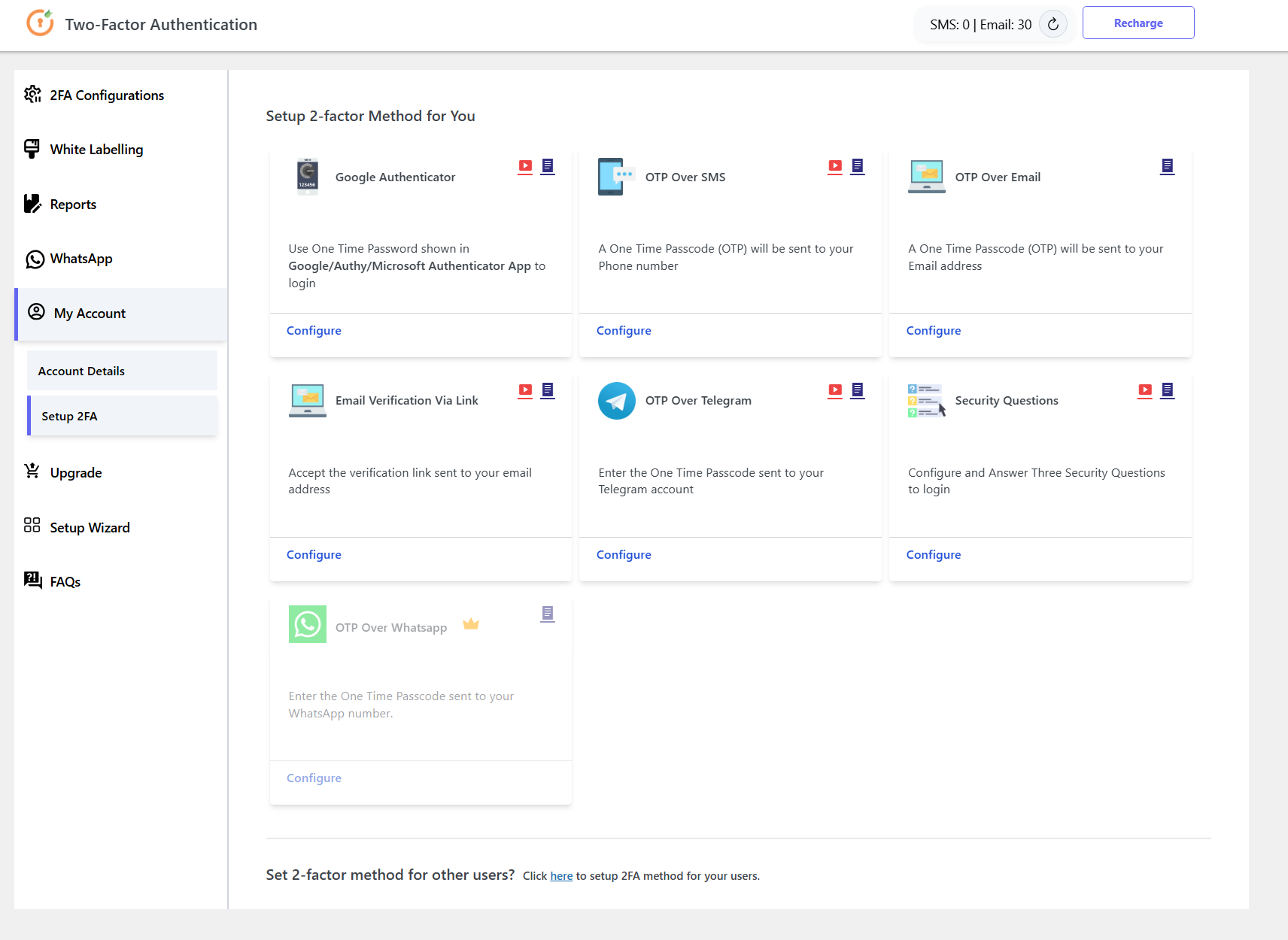
The 2FA plugin supports multiple Two-Factor Authentication (2FA) and Multi-Factor Authentication (MFA) methods, including Google Authenticator, Microsoft Authenticator, Authy, Passkey, Email OTP, SMS OTP, WhatsApp OTP, Telegram OTP, Push Notification, backup codes, security questions, and hardware token authentication.
Whether you manage a WooCommerce store, membership website, LMS platform, enterprise portal, educational institution, government website, or agency-managed environment, WordPress 2FA helps secure user accounts and reduce the risk of account compromise.
The free plan supports unlimited users with Google Authenticator (TOTP), Passkey, Email OTP, and Security Questions. Premium adds more 2FA methods (SMS OTP, WhatsApp OTP, Push Notification, email verification link, and more), enforcement policies, trusted devices, multisite support, custom branding, and more.
Why Use (2FA) Two-Factor Authentication for WordPress?
Protect Administrator Accounts
Administrator accounts are the primary target of attackers. WordPress Two-Factor Authentication (2FA) ensures that only verified users can access administrative dashboards.
Prevent Unauthorized Access
Even if passwords are stolen through phishing attacks or data breaches, additional authentication requirements help prevent unauthorized access.
Improve WordPress Login Security WordPress MFA strengthens login security by combining passwords with additional verification methods.
Reduce Account Takeover Risks Multi-factor authentication significantly reduces the likelihood of successful account takeover attempts.
Secure WooCommerce Customer Accounts
Protect customer profiles, order information, payment details, and store management accounts using WooCommerce Two-Factor Authentication (2FA).
Passkey replaces the password with a cryptographic key stored on the user’s device. Nothing is typed, so nothing can be phished — making Passkey one of the strongest 2FA methods available today, and it’s free in this plugin.
Register a Passkey from the user profile in seconds
Works with Face ID, Touch ID, Windows Hello, and Android biometrics
Works with hardware security keys such as YubiKey, Titan, and SoloKey
Use Passkey as passwordless login or as the second 2FA step
Multiple passkeys per user, with backup codes as fallback
No external calls — Passkey verification happens entirely on your own site
Push Notification 2FA — Premium
Push Notification 2FA sends a login approval request directly to the user’s phone. They tap Approve and the login completes — no six-digit code, no SMS delay, no copy-paste. It’s one of the fastest 2FA methods for teams that log in many times a day.
WordPress 2FA Core Features
miniOrange provides comprehensive WordPress Two-Factor Authentication (2FA) and Multi-Factor Authentication capabilities for websites of all sizes.
Google Authenticator and OTP Authentication for WordPress
Secure WordPress logins using multiple 2FA authentication methods:
Some 2FA methods require communication with miniOrange services to send or verify OTP, SMS, email, push, or account-related requests. These services are used only when you configure or use the related 2FA method.
Passkey and Google Authenticator (TOTP) are verified entirely on your own site and make no external calls.
Secure MCP Server — Turn your WordPress site into a secured MCP (Model Context Protocol) server, so AI agents and assistants can connect to it with proper authentication and access control instead of standing wide open.
Two-factor authentication (2FA) adds a second check after the password. Users verify their identity with something they have, such as a phone or security key, or something they are, such as a fingerprint. Someone who only knows the password can’t log in.
How do I add 2FA to WordPress?
Install and activate the plugin, then follow the setup wizard. Choose a method, test it on your own account, and select the users or roles that must use 2FA.
Is this WordPress 2FA plugin free?
Yes. The free plan covers unlimited users with Passkey, Google Authenticator, Email OTP, security questions, backup codes, role-based policies, WooCommerce 2FA, and passwordless login. Premium adds SMS, WhatsApp, Telegram, push notifications, trusted devices, custom branding, and multisite support.
Does it support Google Authenticator?
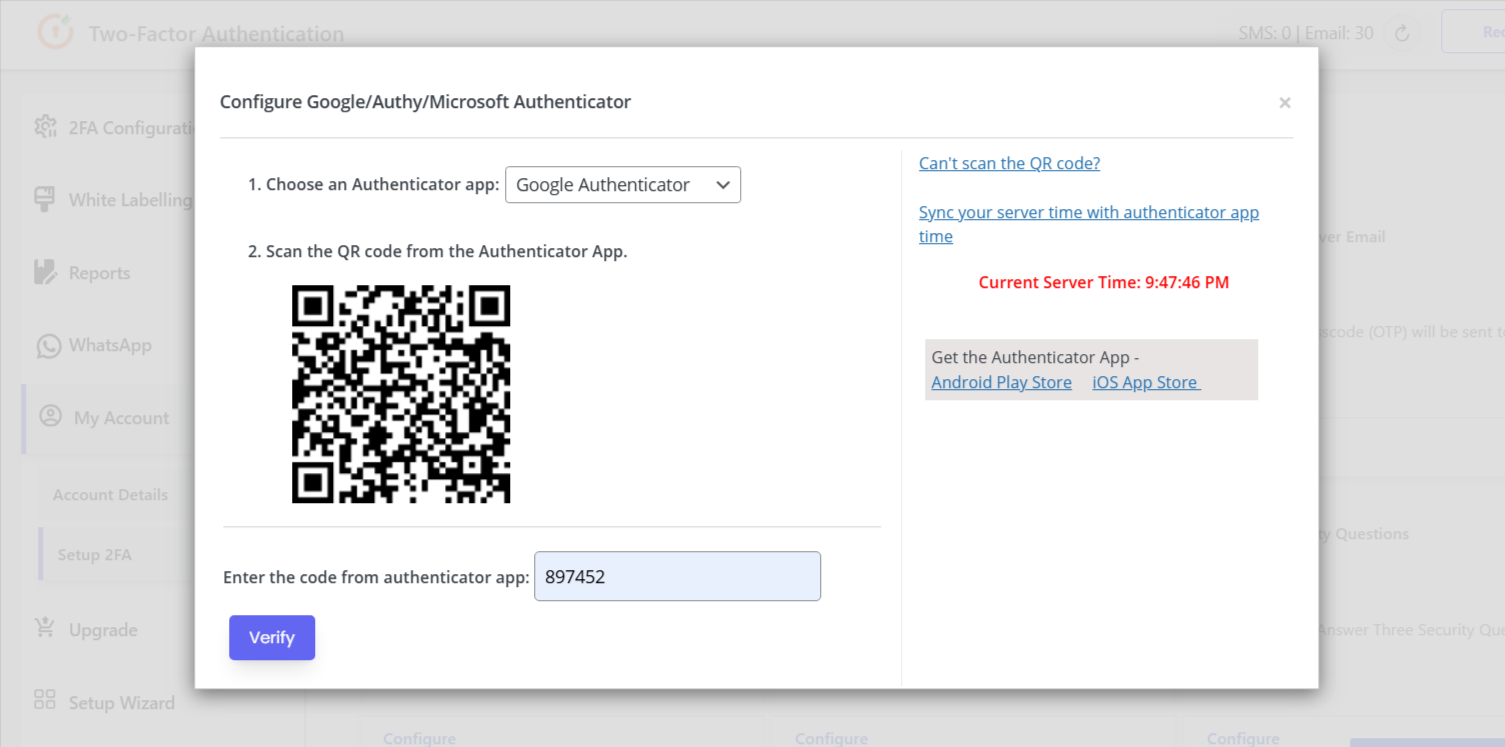
Yes, for free. Users scan a QR code with the Google Authenticator app and enter the 6-digit code when they log in.
Does it support Microsoft Authenticator, Authy, or LastPass Authenticator?
Yes. These apps are supported on Premium.
Does it support passkey login?
Yes, for free. Passkeys use the WebAuthn/FIDO2 standard, so users can sign in with biometrics or a security key, with or without a password.
Can I require 2FA only for administrators?
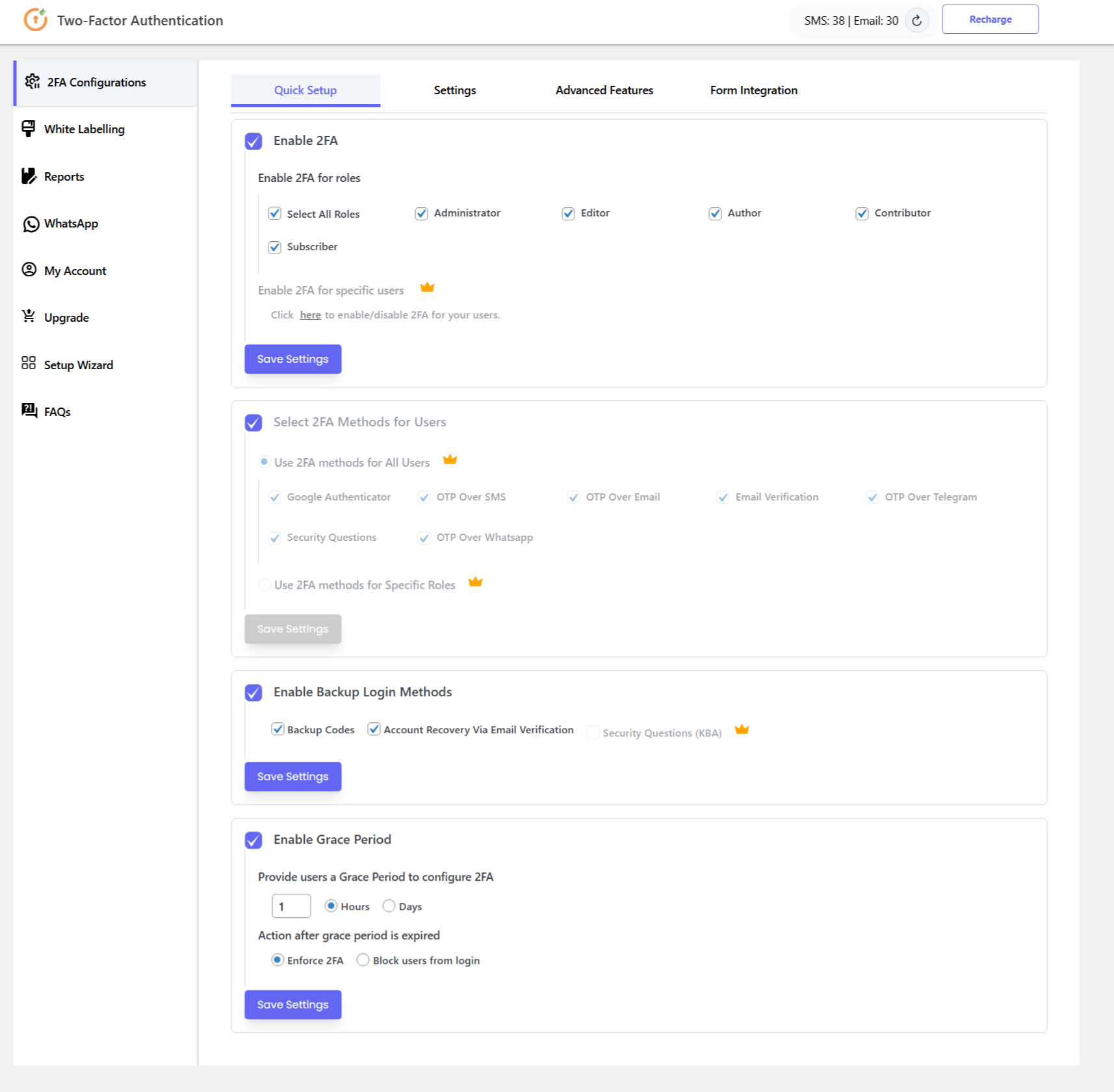
Yes, for free. Role-based policies let you require 2FA for administrators only, for any other role, or for all users.
Can I require 2FA for WooCommerce staff without affecting checkout?
Yes, for free. The “Protect Staff, Not Shoppers” preset on the Quick Setup screen turns on 2FA for Administrator, Editor, Author, and Shop Manager and leaves customers out. You can add customers manually.
Does it support SMS, WhatsApp or Telegram OTP?
Yes, on Premium. Users receive a one-time code by SMS, WhatsApp or Telegram to complete login.
Does it support Push Notification authentication?
Yes, on Premium. Users approve or deny the login request on their registered phone, with no code to type.
Does it support passwordless login?
Yes, for free. Users can sign in with a passkey, a magic link or a one-time code instead of a password.
Does this plugin limit login attempts?
Yes, for free. Under Network Security > Limit Login Attempts, you can block an IP after a set number of failed attempts within a time window. Failed 2FA codes are also rate-limited for each account.
What is the difference between 2FA and MFA?
2FA uses exactly two factors, usually a password plus one more. Multi-factor authentication (MFA) uses two or more. The plugin supports both.
Is my 2FA data sent to miniOrange’s servers?
Not for Passkey or authenticator apps, which run entirely on your site. SMS, WhatsApp, Telegram and Push Notification use miniOrange’s services, because delivering the code requires it.
I already use a security suite with 2FA. Should I switch?
If you need more 2FA methods, role-based enforcement with grace periods, or WooCommerce staff protection, a dedicated 2FA plugin gives you more control. Turn off the 2FA feature in your other plugin so users aren’t asked for two codes.
How do I report a security vulnerability?
Email mfasupport@xecurify.com with “Security” in the subject line rather than disclosing it publicly. Fixed security issues are listed in the changelog with the version that resolved them.
I’m locked out because of 2FA. How do I get back in?
First, use a backup code or the email verification recovery option. If neither works and you have FTP or file manager access, add the MO2F_DISABLE_2FA_ENFORCEMENT constant to wp-config.php above the “stop editing” line. This turns off 2FA enforcement for all users, and a banner in wp-admin reminds you to remove the line once you’re back in.
Feature: Optional setting to let users turn on two-factor authentication for themselves, with a “Turn off” option.
Feature: [mo2f_2fa_setup] shortcode and WooCommerce My Account “Two-factor authentication” tab for front-end 2FA setup.
Feature: Copy and Print buttons for backup codes.
Feature: Admin notice when another two-factor plugin is active alongside this one.
Improvement: Authenticator App secret key is always shown with a Copy button; new keys are 160-bit.
Improvement: User profile shows the active 2FA method with a “Change method” button.
Improvement: One-time code autofill support on the login code boxes; backup code option hidden while a lockout is active.
Improvement: OTP emails fall back to WordPress mail if delivery through miniOrange fails.
Improvement: Dashboard lists the available login methods by name and explains when login reporting is turned off.
Fixed: Access Rules role selection could be lost when “Enable 2FA” was toggled just before saving.
Fixed: WooCommerce My Account 2FA notice now reflects whether 2FA is already set up.
Fixed: Broken Authenticator App icon and Test/Configure buttons on the Setup 2FA page.
Fixed: “[object Object]” shown instead of a proper wait message when an account is temporarily locked out during Authenticator App setup or login.
Improvement: Account lockout during login is now shown as a dedicated page instead of a message inside the login popup.
Improvement: Added a fallback message if the Authenticator App QR code can’t be generated or displayed, so the secret key is still reachable.
Improvement: OTP input fields now bring up a numeric keypad on mobile.
Improvement: Renamed “Google Authenticator” to “Authenticator App” in a few places, since the method also works with Authy, Microsoft Authenticator, and others.
Fixed: Debug Logs Download and Delete actions looking in the wrong folder, so they always reported “file not found” even though the log existed.
Improvement: Added more detailed debug logging across the Authenticator App setup/login flow for easier troubleshooting.
6.7.0
New: Network Security tab, with Website Hardening (Security Headers, Force HTTPS, Hide WordPress Version, Disable Directory Listing, Block Code Execution in Uploads) and Trusted Reverse Proxy/CDN IP detection for IP Blocking and Automatic Lockout.
New: Mixed Content Detection (Premium, All-Inclusive) preview under the Network Security tab.
New: Emergency wp-config.php kill switch (MO2F_DISABLE_2FA_ENFORCEMENT) to disable 2FA enforcement site-wide if locked out.
Security: Google Authenticator secrets are now encrypted at rest instead of stored in plain text.
Fixed: A login-filter priority conflict that could let other plugins interfere with 2FA enforcement, plus a dead AJAX login code path.
Fixed: A race condition in the failed-login attempt counter, missing guards around OTP timing/JSON decoding, and a fatal error in the Duo Security integration.
Improvement: IP Blocking checks now run only on login/XML-RPC requests instead of every page load.
Fixed: Several untranslatable strings on the 2FA OTP challenge popup.
Fixed: A fatal error on sites where another plugin/theme already declared mo2f_mail_tem().
Improvement: Grouped the Role-Based Method Selection (Premium) upsell with the other premium method tiles.
6.6.1
Minor security fixes.
6.6.0
New: Custom Login URL — change wp-login.php to a custom slug, with a loopback check before saving so a bad slug can’t lock you out. (Premium)
New: Country/Region (Geo) Blocking — block or allow logins by visitor country. (Premium, Starter plan+)
New: Slack Alerts — webhook notifications on successful/failed logins, IP blocks, geo-blocked visitors, and 2FA resets. (Premium, All-Inclusive plan)
New: Gravity Forms registration integration, alongside the existing WooCommerce/User Registration/Ultimate Member/Registration Magic tiles.
New: Automatic brute-force lockout — blocks an IP after a configurable number of failed login attempts within a time window, for a configurable duration, extending the existing IP Blocking feature.
New: CIDR notation support (e.g. 192.168.1.0/24) for IP Address Range Blocking, alongside the existing start-end range format.
Security: Fixed a regression where the Enterprise build’s “Disable XML-RPC” setting didn’t actually block XML-RPC requests the way the free build did.
Security: Fixed missing replay protection for Google Authenticator codes — a valid TOTP code could be reused multiple times within its 30-second window.
Security: Added rate limiting to the Enterprise build’s self-service 2FA account-recovery email, matching the limits already applied elsewhere.
Security: The Enterprise build’s session-expiry toggle didn’t actually gate anything — disabling it had no effect, and an unconfigured install got a flat 14-day login cookie regardless of Remember Me. Fixed to respect the toggle and fall back to WordPress’s own default.
Security: Removed a dead, crash-prone admin-notification option left over from an older product line; enabling it (possible via a migrated database) fataled the next time an IP was blocked.
Fixes: Corrected an Enterprise build outbound API call timeout that was set to ~2.8 hours instead of 10 seconds.
Improvement: Widened Google Authenticator’s clock-drift tolerance to +/-60 seconds in the Enterprise build, matching the free build.
Fixes: Removed stray PHP warnings logged by the self-service 2FA reset endpoint when handling a stale/orphaned reset token.
Fixes: Several internal classes (settings handlers, IP blocking, AJAX handling, and the 2FA reconfiguration-link handler) were being constructed twice per request due to a duplicate-initialization pattern, causing some of their actions to run twice; corrected across 8 classes.
Fixes: Corrected a UI spacing issue between the Geo Blocking “Countries” field and the row above it, and between the navbar’s “2FA + Website Security” toggle and the elements before it.
Fixes: Moved the “IP Blocking” sidebar menu item to sit above Reports instead of always appearing at the very end of the menu.
Fixes: Restyled the IP Blocking tab (Advanced Blocking / IP Blacklist) to match the rest of the redesigned admin UI, and fixed the AJAX-refreshed tables reverting to legacy styling immediately after blocking, unblocking, whitelisting, or removing an IP.
Fixes: The “2FA + Website Security” toggle in the admin header required a manual page refresh before the change (e.g. the IP Blocking menu item appearing/disappearing) was reflected.
Improvement: Visually separated the Advanced Features tab’s heading from its settings list, and grouped related settings — including the new automatic brute-force lockout setting — so each renders as its own distinct, separated block instead of blending together.
Security: Fixed a timing issue in the per-attempt 2FA lockout counter where it could silently expire mid-challenge — most noticeable with Passkey, since a fingerprint/security-key prompt often takes longer than the window allowed — locking an account out after only 2-3 tries instead of the intended budget.
Security: Neither the IP Blacklist nor the IP Range/CIDR blocking tools stopped you from blocking your own current IP, which locks you out of the entire site with no way back in. Both now refuse to save an entry that matches your own current IP.
Fixes: A missing user lookup during a failed login attempt could log a confusing error and silently skip the failed-login notification email.
Improvement: Passkey now appears directly after Authenticator App in the 2FA method list during setup, ahead of the OTP-based methods.
6.5.0
New: Optional daily/weekly Activity Digest email summarizing new logins, failed login attempts, and 2FA resets, sent to configured recipients or all administrators by default.
New: Optional CAPTCHA (Google reCAPTCHA v2 or Cloudflare Turnstile) on the wp-login.php login form, to slow down automated brute-force login attempts.
Security: Added a “Disable XML-RPC” option under 2FA Configurations > Advanced Features, to close off xmlrpc.php as a brute-force and DDoS-amplification vector on sites that don’t need it. Off by default so existing Jetpack/mobile-app integrations keep working after upgrade.
New: Self-service 2FA account recovery can now be restricted to specific roles, and the site admin can optionally get an email whenever a user resets their own 2FA this way. Also now recorded in the Compliance Log alongside admin-initiated resets.
Improvement: The miniOrange account creation screen now explains what the account is used for (SMS/WhatsApp delivery, plan management), with a “Skip for now” option.
Improvement: Modernized the admin sidebar navigation — refreshed icons and hover/active states.
6.4.0
New: Magic Link Login — a passwordless “email me a login link” option at wp-login.php, with Off / Optional / Mandatory modes.
New: Trusted Devices (free) — a recognized browser skips repeat 2FA prompts for 7 days after a successful challenge.
New: Recent Logins panel — self-service login history (date, IP, success/failure) on each user’s own profile.
New: 2FA Adoption dashboard widget showing how many required users have 2FA configured.
New: Optional 2FA setup reminder emails for users who are required to set up 2FA but haven’t yet.
New: Security alert email sent to a user when their 2FA method is changed, or reset by an admin.
New: “Protect Staff, Not Shoppers” one-click WooCommerce role preset on the Quick Setup screen (Administrator, Editor, Author, Shop Manager; Customer left unchecked).
New: Optional security note on the WooCommerce My Account dashboard, shown only when WooCommerce is active.
New: Per-role grace periods, and a per-role action (enforce vs. block) for when a role’s grace period expires, in addition to the existing site-wide default.
New: Compliance Log report under Reports — records admin-initiated 2FA resets (who, whom, when) for PCI DSS / GDPR / cyber-insurance documentation. Export is a Premium feature.
Improvement: Plugin emails (OTP, verification links, backup codes, setup reminders, and more) now send through miniOrange’s cloud relay instead of the site’s local SMTP, so delivery no longer depends on the site having SMTP configured.
Improvement: Redesigned admin UI — the 2FA Configurations screen is now split into focused Access Rules, Login Experience, Methods, Notifications, and Advanced pages with WordPress-native styling.
Improvement: Backup codes are now generated and validated locally instead of via a remote service call.
Security: Closed a gap where the free plugin’s SMS and Email-Verification-Link methods could be used on the backend despite being premium-locked in the UI.
Security: Fixed missing rate limiting on backup-code validation, which allowed unlimited guesses; it now uses the same account lockout as every other 2FA method.
Security: Added rate limiting (a short per-request cooldown, an hourly cap per user/IP/destination, and a site-wide daily cap) to every email the plugin sends on demand — OTP over email, backup-code resends, and account-recovery link resends — so none of them can be used to spam a user’s inbox or exhaust the site’s email quota.
Security: Fixed a sanitization-ordering bug where a request URL was written to the audit log before, not after, being passed through esc_url_raw().
Security: Added a missing capability check on the setup-wizard “skip” action, which was reachable by an unauthenticated visitor via the nonce embedded in the public login-challenge popup.
Security: Removed a minor information disclosure where the account-recovery email failure message differed depending on whether the target account could manage_options.
6.3.2
Security fixes and improvements.
6.3.1
Fixed unauthenticated arbitrary WordPress option deletion via the email-verification link handler.
Fixed 2FA attempt-lockout bypass (client-controlled counter) and added missing rate limiting to the 2FA configuration-validation endpoint.
6.3.0
Compatibility with WordPress 7.1
6.2.9
Free 2FA now supports unlimited users completing two-factor authentication setup.
Introduced Passkey as a new 2FA method in the free version.
Introduced Push Notification as a new premium 2FA method.
Performance optimizations across the 2FA plugin.
6.2.8
Bug fixes for TOTP method and KBA method
Minor bug fixes and improvements.
6.2.7
Added rate limiting
other bug fixes
6.2.6
Readme changes.
Security fixes.
6.2.5
Increased the free 2FA setup limit so up to 5 users can complete two-factor authentication configuration.
Updated account recovery email behavior so the recovery link can be sent without checking remaining email transactions.
UI Improvements in 2FA plugin.
2FA plugin readme changes.
Compatibility with WordPress 7.0
6.2.4
Bug fixes in WP 2FA plugin
Readme updates in 2FA plugin
6.2.3
Readme updates in 2FA plugin
6.2.2
Readme updates in 2FA plugin
6.2.1
Security fixes in 2FA plugin
Readme updates in 2FA plugin
6.2.0
UI Updates – 2FA Settings
6.1.7
Minor Fixes – 2FA User Profile
6.1.5
Security fixes in 2FA plugin
Code optimization changes
6.1.4
Bug fixes – 2FA login flow
Code optimization changes in WP 2FA
6.1.3
Vulnerability fixes – Admin XSS/MITM risk via IP Lookup