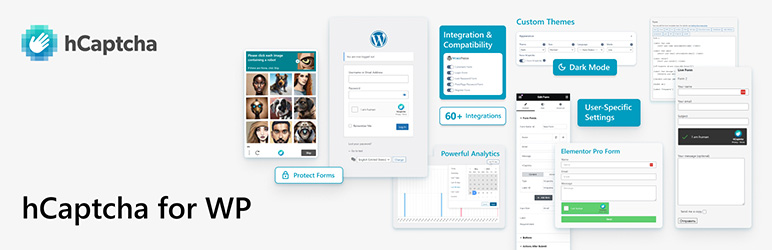
The strongest CAPTCHA. Switch from reCAPTCHA and Turnstile for free.
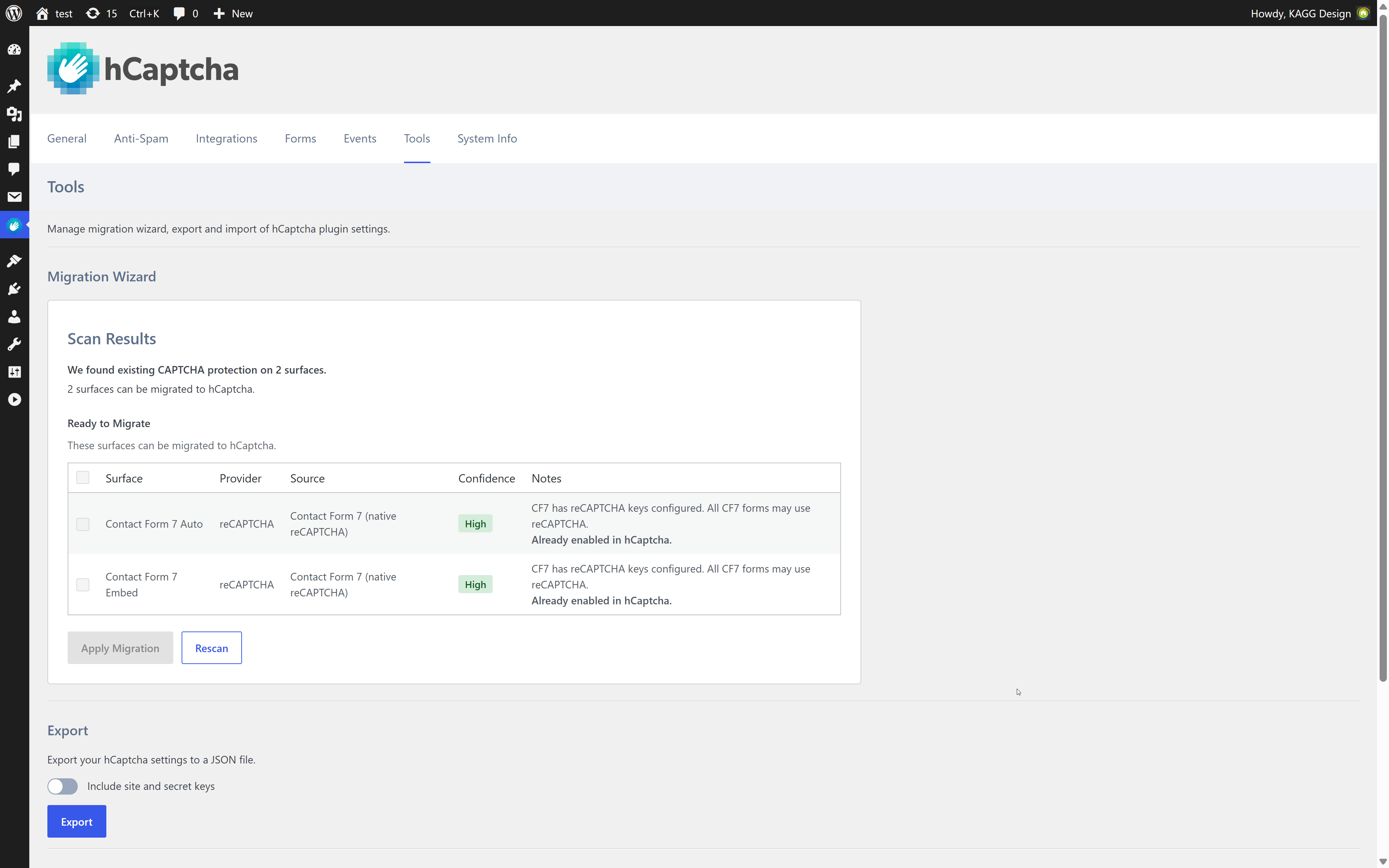
A built-in Migration Wizard helps you move from Google reCAPTCHA or Cloudflare Turnstile to hCaptcha in just a few clicks.
Need to keep out bots? hCaptcha protects privacy while offering better protection against spam and abuse. Help build a better web.
The purpose of a CAPTCHA is to distinguish between people and machines via a challenge-response test and thus increase the cost of spamming or otherwise abusing websites by keeping out bots.
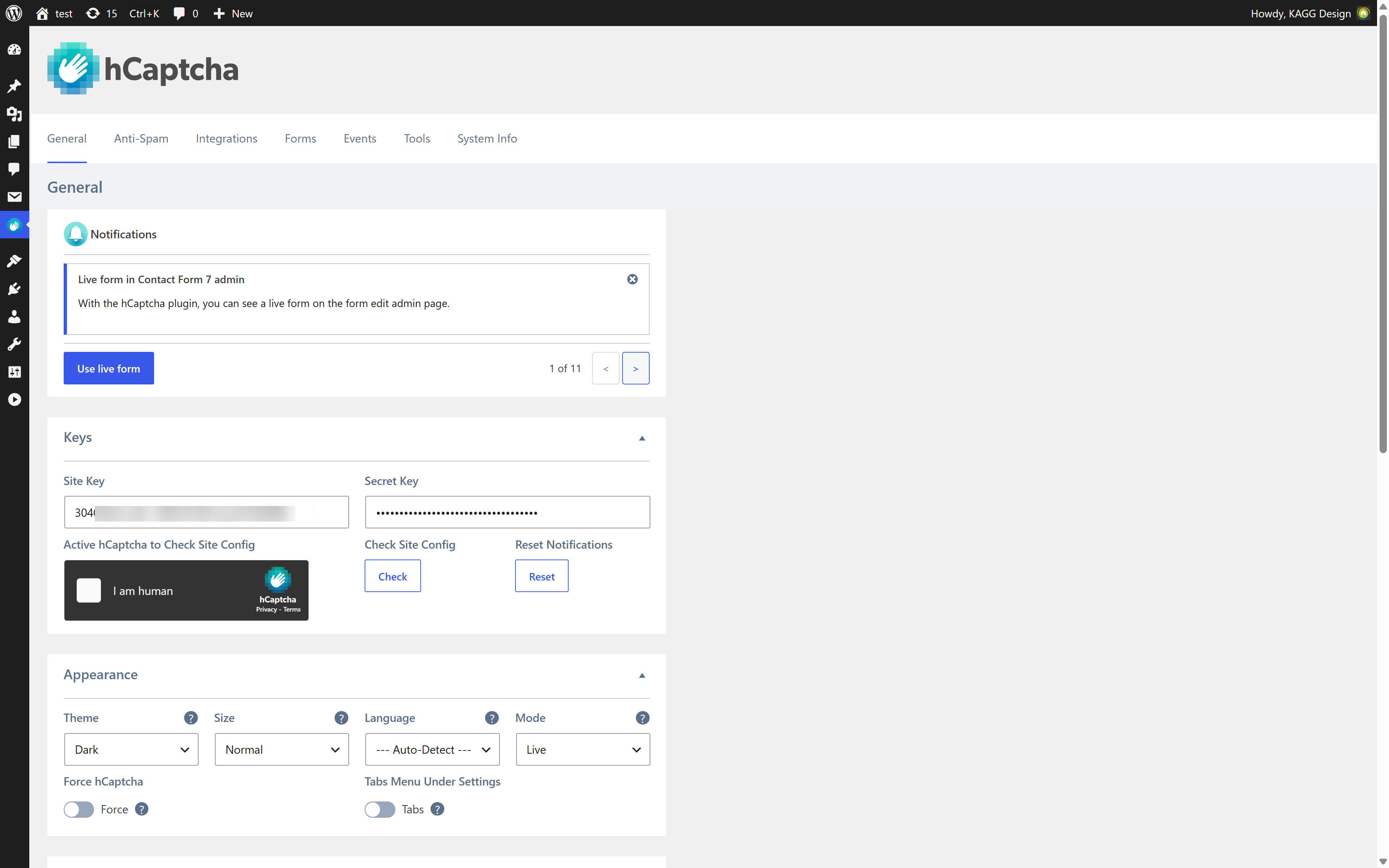
To use this plugin, install it and enter your sitekey and secret in the Settings → hCaptcha menu after signing up on hCaptcha.com.
hCaptcha is designed to comply with privacy laws in every country, including GDPR, LGPD, CCPA, and more.
For example, hCaptcha has been certified under ISO 27001 and 27701 and is enrolled in the EU-US, UK-US, and Swiss-US Data Privacy Framework for GDPR compliance.
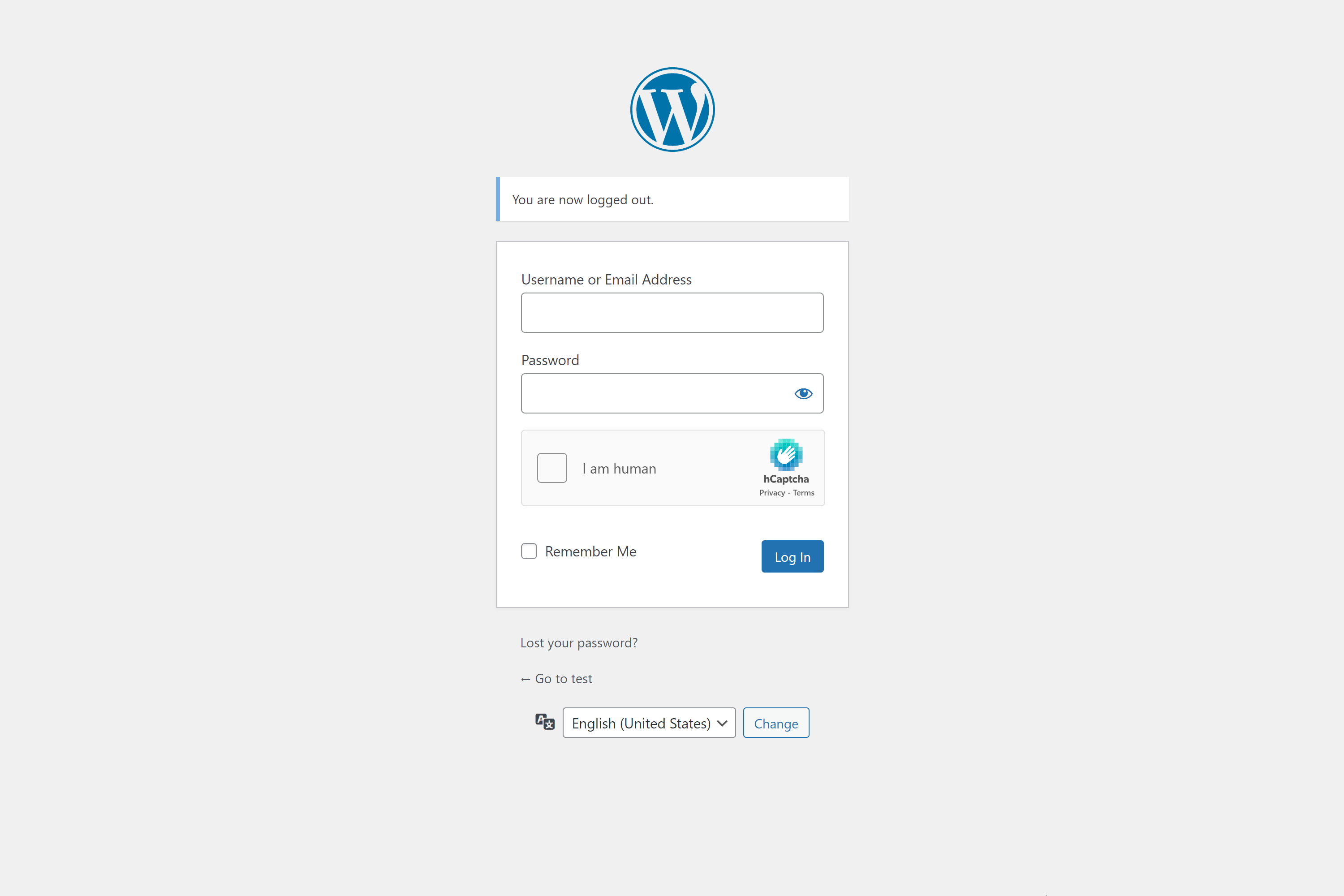
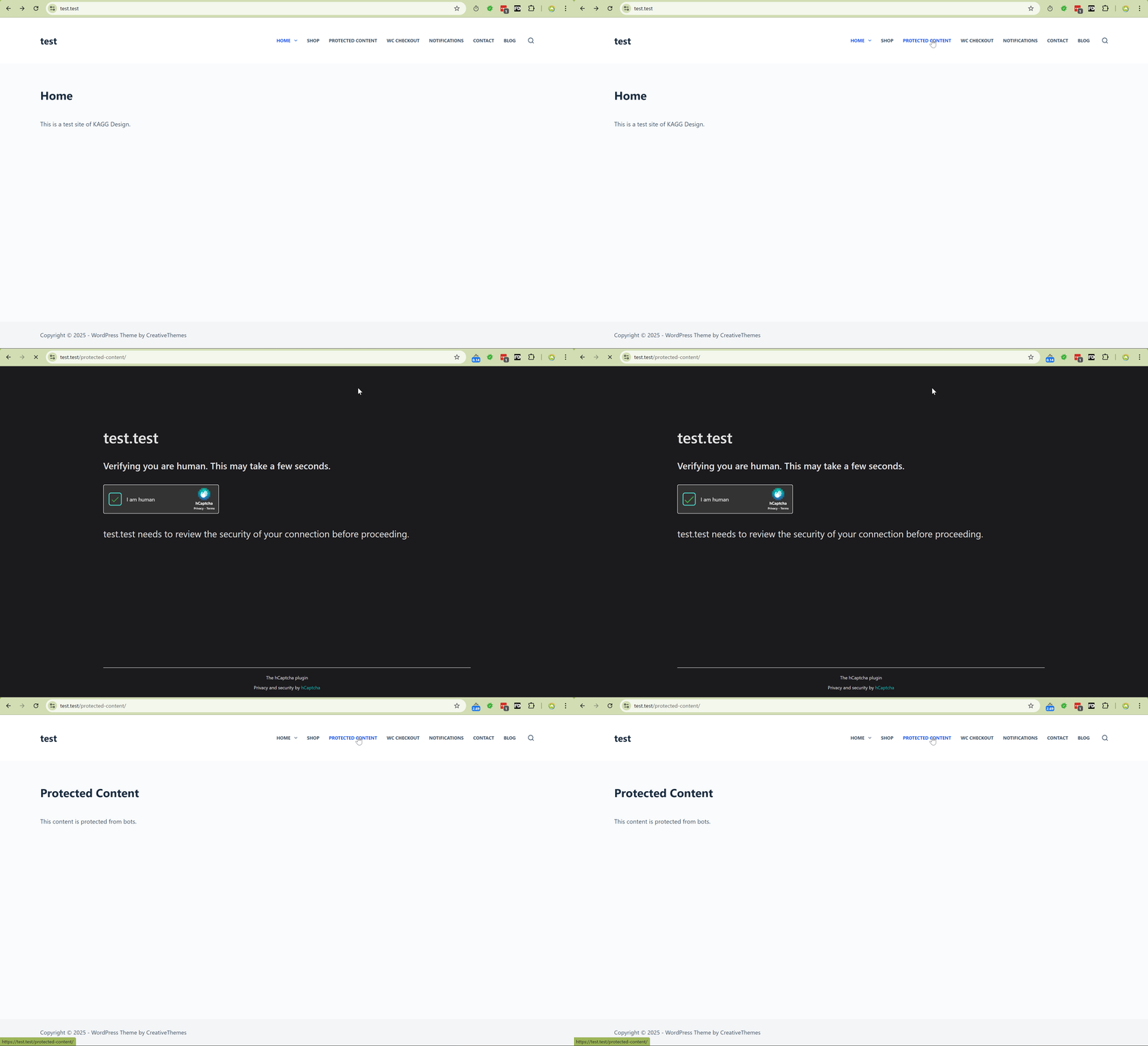
If you enable CAPTCHA protection for native WordPress password-protected posts, the plugin sets a first-party hcaptcha_postpass_ cookie after successful verification. It contains signed proof of the password scope without the password itself and follows the native post-password cookie lifetime, including session cookies. Existing post-password cookies without this proof require another password-form submission with CAPTCHA. REST password attempts are rejected while this protection is enabled; editor authorization remains available.
Once you activate this plugin, the hCaptcha-answering user’s IP address and browser data may be sent to the hCaptcha service on pages where you have activated hCaptcha protection. However, hCaptcha is designed to minimize data used, process it very close to the user, and rapidly discard it after analysis.
For more details, please see the hCaptcha privacy policy at:
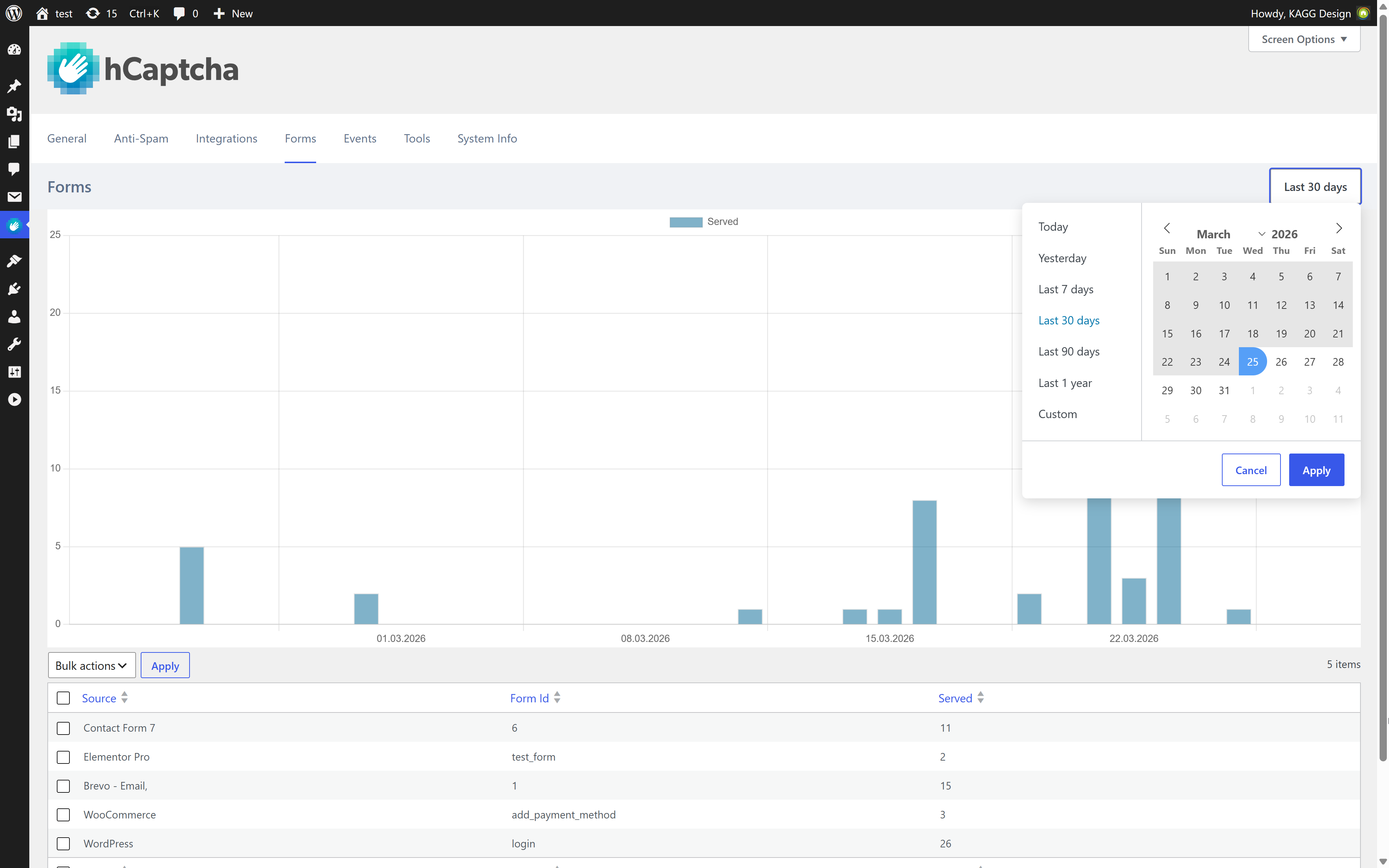
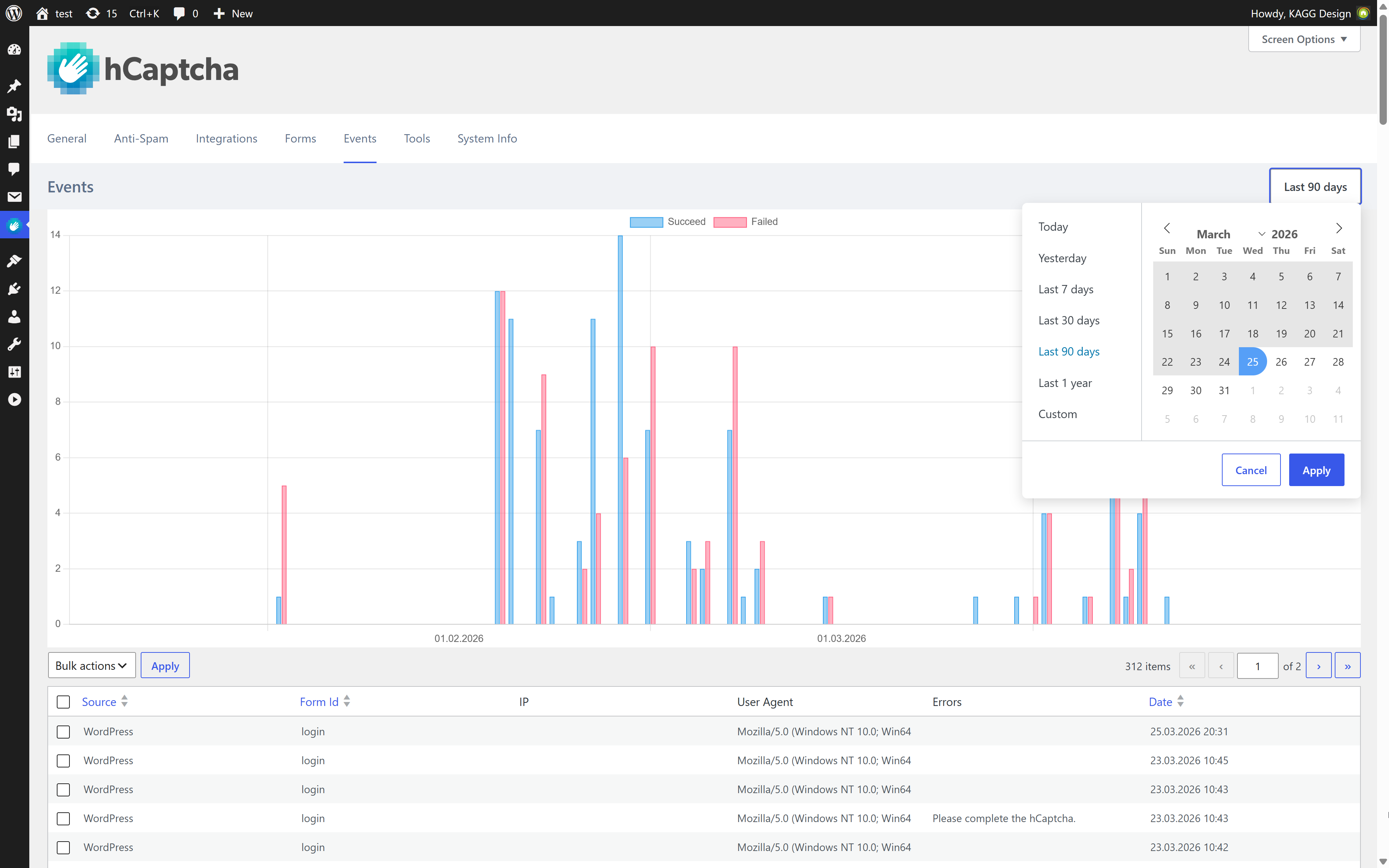
If you enable the optional plugin-local statistics feature, the following additional data will be recorded in your database:
We recommend leaving IP and User Agent recording off. In that configuration, the local event records do not contain either value.
The separate Collect Anonymously setting controls only local event storage. If IP address or User Agent collection is enabled, this setting stores those values as salted hashes instead of their original values.
Statistics is optional and off by default. Enabling it sends the visitor IP of the current request (X-Forwarded-For), the full site URL with /plugin-stats appended, and plugin configuration to hCaptcha at https://a.hcaptcha.com/api/event to help prioritize plugin development. Configuration includes the plugin version, license type, active integrations and their enabled forms, multisite status, and site/secret key presence flags, without key values. Reports are sent when Statistics is turned on and on initialization after plugin updates. The IP belongs to the request triggering the report, which may be an administrator or cron request; if no public IP is available, 127.0.0.1 is sent as a fallback. The recipient also receives ordinary network metadata, such as the server IP. Collect Anonymously, Collect IP, and Collect User Agent affect only local event storage, not these reports. Custom code can force or filter sends even with Statistics off.
The existing telemetry transport is retained for compatibility. It posts JSON with Content-Type: application/json, a fixed browser-style User-Agent (not the visitor browser value), and X-Forwarded-For containing the IP selected by the plugin from the current request using its trusted IP header settings/filter, or the 127.0.0.1 fallback. This fallback is not an anonymized visitor IP. The JSON fields are d (wp-plugin.hcaptcha.com), n (plugin-stats), u (the full home_url('plugin-stats'), including any installation path), r (null), w (the fixed value 1024), and props (configuration). The configuration fields are hCaptcha, License, Site key, Secret key, Multisite, Active, and active integration names with their enabled form identifiers. At most 30 configuration fields are sent, with Active limited to 2000 characters. Site key and Secret key are presence flags (0 or 1); their values are not sent. Local event records are not included in the remote report.
We also suggest emailing the authors of plugins you’d like to support hCaptcha: it will usually take them only an hour or two to add native support. This will simplify your use of hCaptcha and is the best solution in the long run.
You may use native hCaptcha support if available for your plugin. Please check with your plugin author if native support is not yet available.
However, the hCaptcha plugin provides a broader set of options and features so that you can use it with any form on your site.
How do I use the hCaptcha plugin?
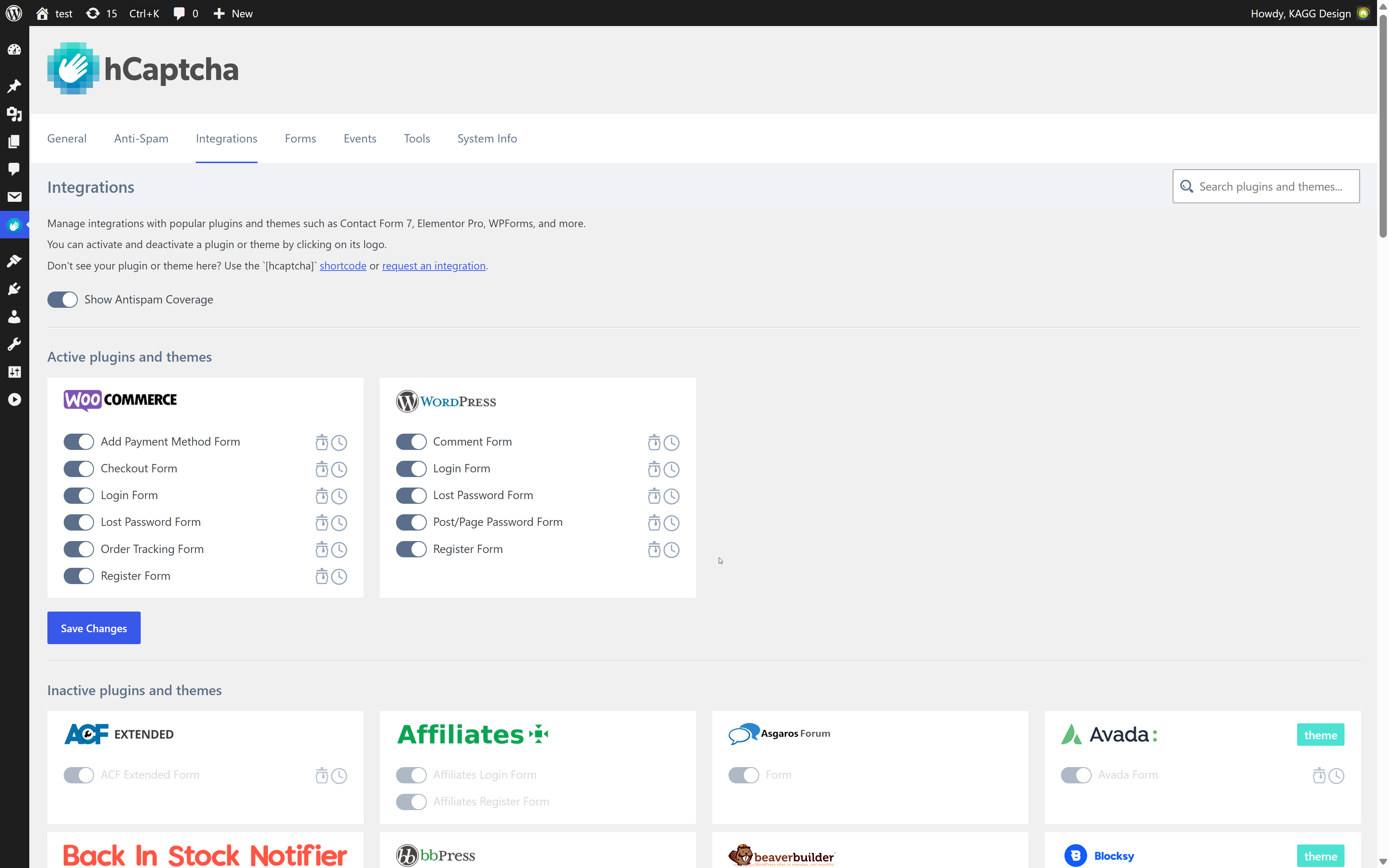
The hCaptcha plugin supports WordPress core and many plugins with forms automatically. You should select the supported forms on the hCaptcha Integrations settings page.
For non-standard cases, you can use the [hcaptcha] shortcode provided by the plugin.
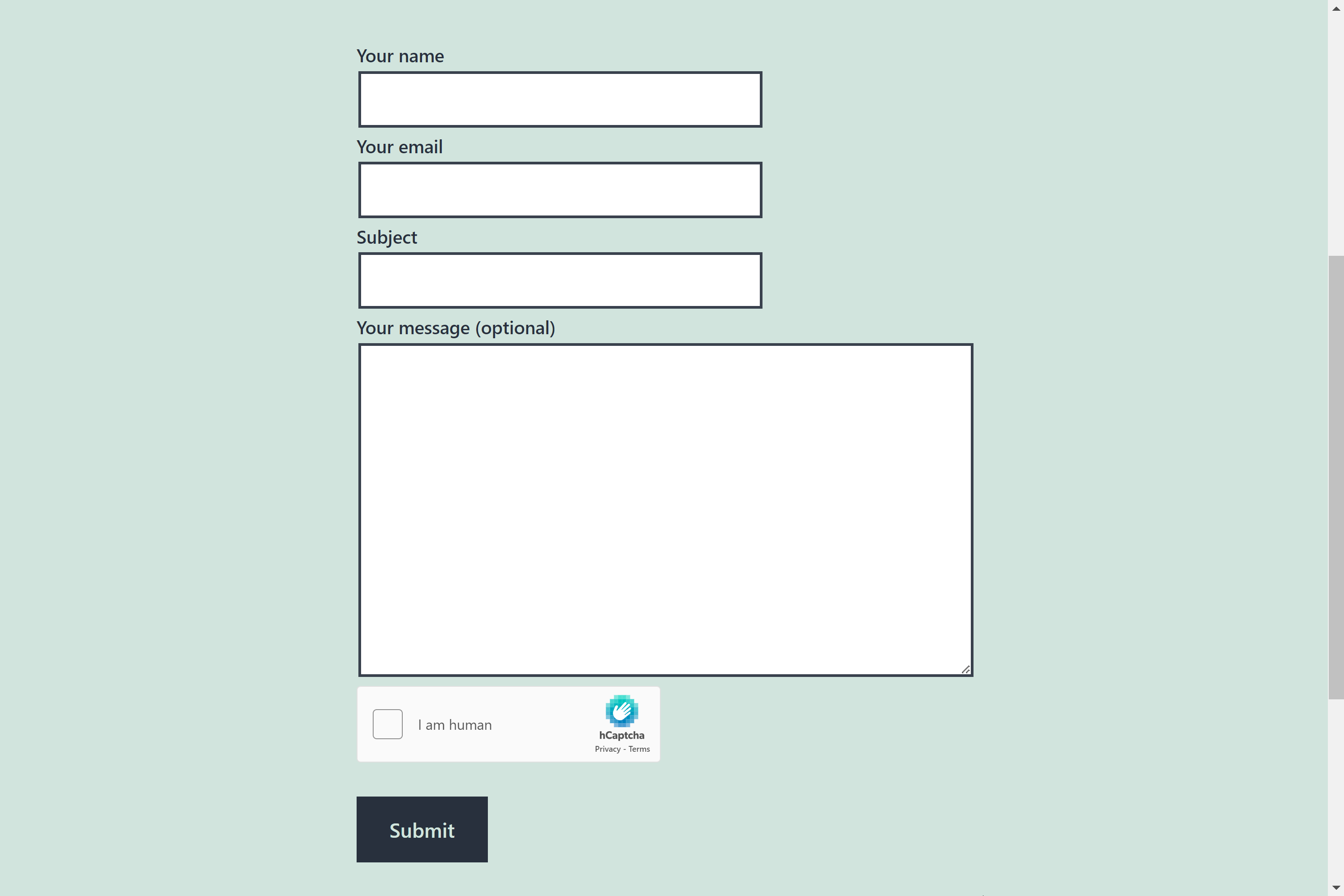
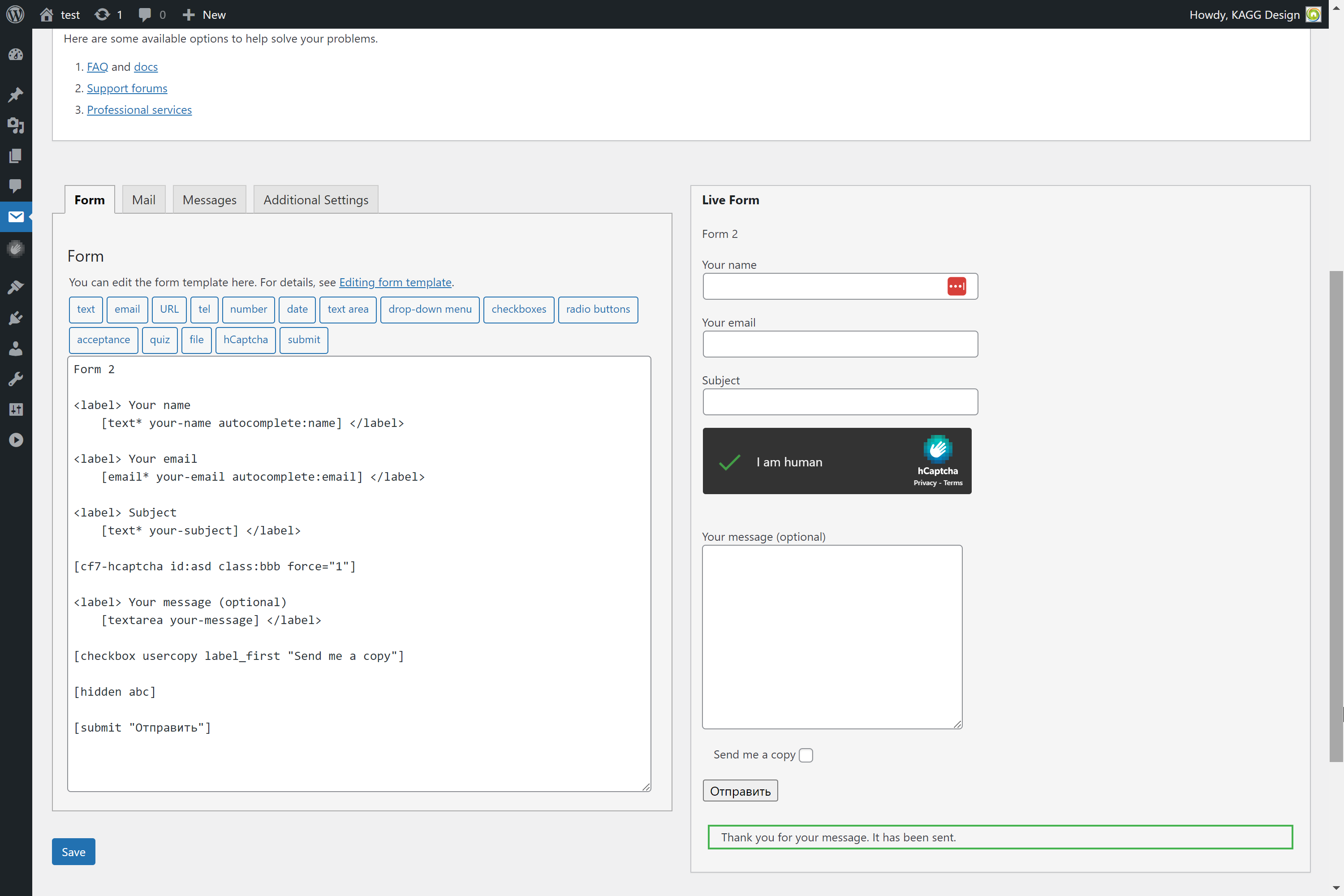
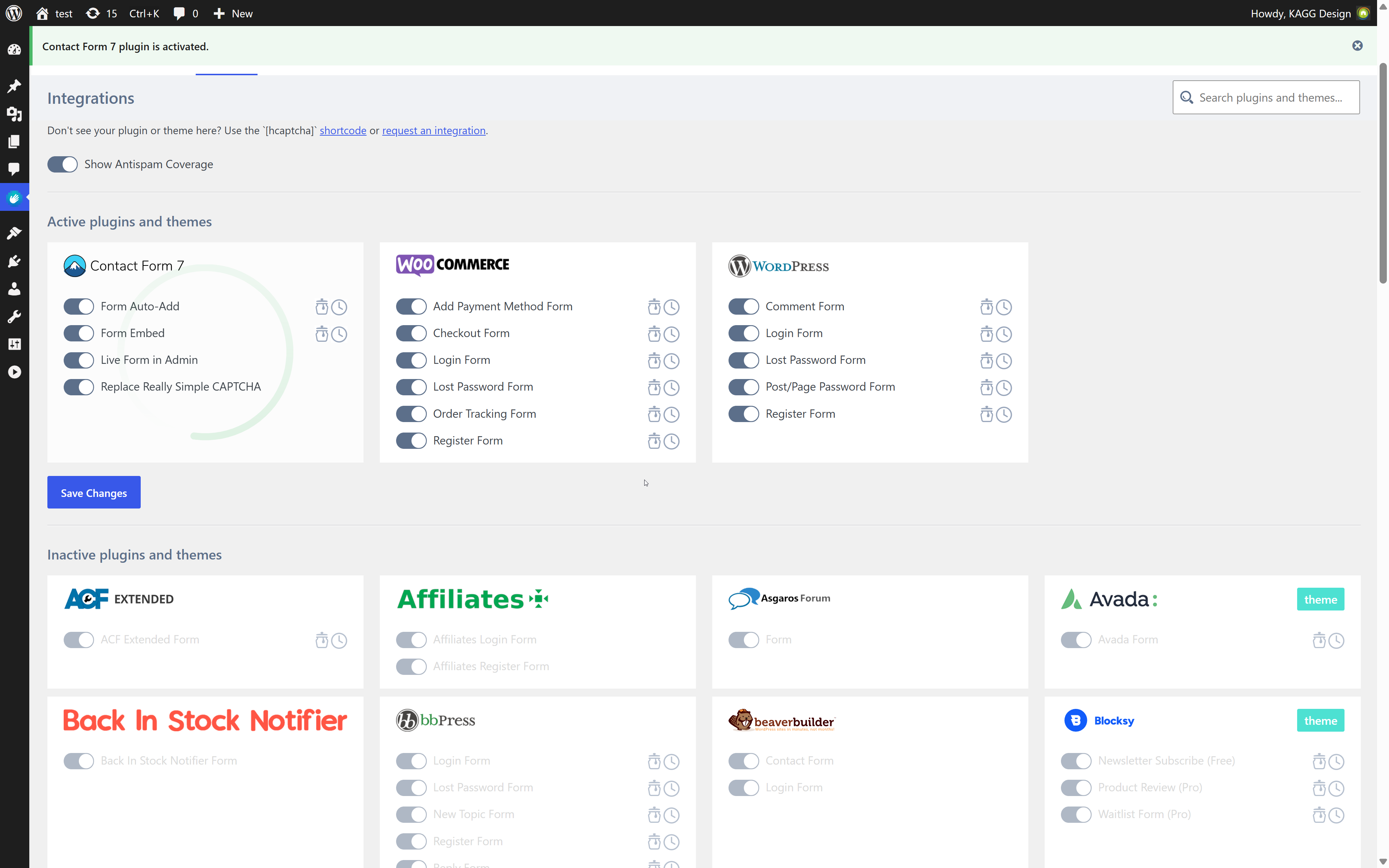
For example, we support Contact Forms 7 automatically. However, sometimes a theme can modify the form. In this case, you can manually add the [cf7-hcaptcha] shortcode to the CF7 form.
To make hCaptcha work, the shortcode must be inside the
…
tag.
How do I migrate from reCAPTCHA or Turnstile?
Go to Settings → hCaptcha → Tools and use the Migration Wizard.
It scans your site for existing CAPTCHA providers, shows what can be migrated, and applies the changes in one click.
How do I use the new AI / Abilities features?
hCaptcha exposes selected security actions via the WordPress Abilities API for use with automation tools, WP-CLI, and AI agents, making it suitable for agencies managing multiple WordPress sites. Requires WordPress 6.9 or newer.
The typical workflow consists of two steps: inspect threats and block offenders.
** 1. Inspect recent threat activity **
You can request an aggregated threat snapshot for a given time window.
Using WP-CLI:
wp ability run hcaptcha/get-threat-snapshot --input='{"window":"55d"}' --user=admin
Using REST API (authenticated):
curl --globoff -u "USER:APP_PASSWORD" \
"https://example.com/wp-json/wp-abilities/v1/abilities/hcaptcha/get-threat-snapshot/run?input[window]=55d"
The response includes:
* overall metrics (total requests, failure rate)
* confidence and top error vectors
* breakdown by error type and form source
* a list of top offenders (if present)
Example (simplified):
{
  "metrics": { "total": 353, "failed": 215, "fail_rate": "0.61" },
  "signals": { "confidence": "high", "top_vectors": ["empty", "spam"] },
  "breakdown": {
    "errors": { "empty": 160, "spam": 16 },
    "offenders": [
      {
        "offender_id": "a1376a016c4156933c4d49b0bc56fa01",
        "type": "ip",
        "count": 2
      }
    ]
  }
}
** 2. Block abusive offenders **
If an offender appears suspicious, you can block it using its offender_id.
Using WP-CLI:
wp ability run hcaptcha/block-offenders \
--input='{"offender_ids":["a1376a016c4156933c4d49b0bc56fa01"]}' \
--user=admin
Using REST API (authenticated):
curl --globoff -u "USER:APP_PASSWORD" \
"https://example.com/wp-json/wp-abilities/v1/abilities/hcaptcha/block-offenders/run?input[offender_ids][]=a1376a016c4156933c4d49b0bc56fa01"
Example response:
{
  "blocked": ["a1376a016c4156933c4d49b0bc56fa01"],
  "effective_until": "2026-01-01T22:22:09Z"
}
** What is offender_id? **
offender_id is a stable hash of the IP address.
Raw IP addresses are never exposed to automation clients or AI agents.
This allows privacy-safe analysis and blocking, while still enabling deterministic enforcement.
** Can AI agents use this automatically? **
Yes.
You can point an AI agent to a WordPress site with Abilities enabled and instruct it to:
* discover available abilities
* collect threat statistics
* decide whether activity looks abusive
* block the most active offenders
Internally, the agent performs the same commands shown above (wp ability list, get-threat-snapshot, block-offenders).
** 3. Export plugin settings **
You can export current plugin settings as JSON (optionally including keys) for backup or migration.
Using WP-CLI:
wp ability run hcaptcha/export-settings --include_keys --user=admin
Using REST API (authenticated):
curl --globoff -u "USER:APP_PASSWORD" \
"https://example.com/wp-json/wp-abilities/v1/abilities/hcaptcha/export-settings/run?input[include_keys]=1"
** 4. Import plugin settings **
Import settings from a JSON file path on the server. Use allow_keys to apply the keys block and dry_run to validate without saving.
Using WP-CLI:
wp ability run hcaptcha/import-settings --allow_keys --dry-run=false --user=igor --input_file=1.json
Using REST API (authenticated):
curl --globoff -u "USER:APP_PASSWORD" \
"https://example.com/wp-json/wp-abilities/v1/abilities/hcaptcha/import-settings/run?input[input_file]=%2Fpath%2Fto%2Fhcaptcha-settings.json&input[allow_keys]=1&input[dry_run]=0"
WP-CLI commands for exporting and importing settings
The plugin also adds the wp hcaptcha export and wp hcaptcha import commands.
Export settings
`
wp hcaptcha export –pretty > hcaptcha-settings.json
wp hcaptcha export –include-keys –file=./hcaptcha-settings.json
`
Parameters:
* --include-keys — include the site_key and secret_key values.
* --pretty — pretty-print JSON for readability.
* --file=<path> — write JSON to a file instead of STDOUT.
Import settings
`
wp hcaptcha import ./hcaptcha-settings.json
wp hcaptcha import ./hcaptcha-settings.json –dry-run
wp hcaptcha import ./hcaptcha-settings.json –allow-keys
`
Parameters:
* --dry-run — validate the JSON without saving.
* --allow-keys — allow importing keys from the keys block.
You don’t support plugin X. How can I get support for it added?
Open a PR on GitHub: or just email the authors of plugin X. Adding hCaptcha support is typically quite a quick task for most plugins.
Does the [hcaptcha] shortcode have arguments?
Full list of arguments:
[hcaptcha action="my_hcap_action" name="my_hcap_name" auto="true|false" ajax="true|false" force="true|false" theme="light|dark|auto" size="normal|compact|invisible" honeypot="true|false"]
The shortcode adds not only the hCaptcha div to the form but also a nonce field. You can set your own nonce action and name. For this, use arguments in the shortcode:
[hcaptcha action="my_hcap_action" name="my_hcap_name"]
and in the verification:
$result = \HCaptcha\Helpers\API::verify_post( 'my_hcap_name', 'my_hcap_action' );
For the explanation of the auto=”true|false” argument, see the section “How to automatically verify an arbitrary form”. By default, auto="false".
The argument force=”true|false” allows forcing verification of hCaptcha widget before submitting the form. By default, force="false".
The argument size=”normal|compact|invisible” allows setting the size of hCaptcha widget. By default, size="normal".
The argument honeypot=”true|false” allows enabling or disabling the honeypot for the shortcode form. By default, it follows the global Honeypot setting.
How to add hCaptcha to an arbitrary form
First, add the hCaptcha snippet to the form.
If you create the form as an HTML block in the post content, insert the shortcode [hcaptcha] inside it. It may look like this:
<form method="post">
    <input type="text" name="test_input">
    <input type="submit" value="Send">
    [hcaptcha]
</form>
If you create the form programmatically, insert the following statement inside it:
?>
<form method="post">
    <input type="text" name="test_input">
    <input type="submit" value="Send">
    <?php echo do_shortcode( '[hcaptcha]' ); ?>
</form>
<?php
Secondly, verify the result of hCaptcha challenge.
$result = \HCaptcha\Helpers\API::verify_request();

if ( null !== $result ) {
    echo esc_html( $result );
    // Block processing of the form.
}
How to honor per-form protection exemptions in custom handlers
Custom verification helpers always require a valid CAPTCHA response unless the server supplies the expected form identity. To honor a per-form hcap_protect_form exemption, pass the same server-selected source and form_id used to render the widget: API::verify_post( $nonce_name, $nonce_action, $expected_id ), API::verify_post_html( $nonce_name, $nonce_action, $expected_id ), or API::verify_post_data( $nonce_name, $nonce_action, $post_data, $expected_id ). For API::verify_request() and API::verify(), use the entry’s expected_id key. Derive that identity from the native form being processed, independently of the submitted hcaptcha-widget-id.
When a handler cannot identify the submitted form independently, set mandatory to true in the arguments passed to HCaptcha::form() or HCaptcha::form_display(). This keeps the required challenge and nonce visible even when a per-form exemption is configured. Asgaros, Passster, and PayPal order creation use this mode; PayPal also requires the checkout widget it shares. Icegram’s generic form without a native form ID requires the challenge too. Other forms with a matching server-selected identity retain their per-form exemptions.
How to automatically verify an arbitrary form
Arbitrary user forms can be verified easily. Just add auto="true" or auto="1" to the shortcode:
[hcaptcha auto="true"]
and insert this shortcode into your form.
Auto-verification works with forms sent by POST on frontend only. It works with forms in the post content and in widgets.
You can add also force="true" or force="1" argument to prevent sending a form without checking the hCaptcha.
[hcaptcha auto="true" force="true"]
Arbitrary forms can also be submitted via AJAX using the ajax argument. For backward compatibility, the shortcode enables automatic verification when ajax="true" is set and auto is omitted.
[hcaptcha ajax="true"]
If your code verifies the form itself, use [hcaptcha ajax="true" auto="false"]. The same applies to HCaptcha::form() in PHP: specify auto=false to use AJAX submission with your own verifier.
How to block hCaptcha entirely on a specific page?
hCaptcha starts early, so you cannot use standard WP functions to determine the page. For instance, to block it on my-account page, add the following code to your plugin’s (or mu-plugin’s) main file. This code won’t work being added to a theme’s functions.php file.
/**
 * Filter hCaptcha activation flag.
 *
 * @param bool|mixed $activate The activate flag.
 *
 * @return bool
 */
function my_hcap_activate( $activate ): bool {
  $status = (bool) $status;

  $url = isset( $_SERVER['REQUEST_URI'] ) ?
    filter_var( wp_unslash( $_SERVER['REQUEST_URI'] ), FILTER_SANITIZE_FULL_SPECIAL_CHARS ) :
    '';

  if ( '/my-account/' === $url ) {
    return false;
  }

  return $activate;
}

add_filter( 'hcap_activate', 'my_hcap_activate' );
How do I block hCaptcha scripts everywhere except on a specific page?
As an example, to block hCaptcha scripts everywhere except on the contact page:
/**
 * Block inline styles.
 *
 * @return void
 */
function hcap_block_inline_styles() {
    if ( is_page( 'contact' ) ) {
        return;
    }

    $hcaptcha = hcaptcha();

    remove_action( 'wp_head', [ $hcaptcha, 'print_inline_styles' ] );
    remove_filter( 'wp_resource_hints', [ $hcaptcha, 'prefetch_hcaptcha_dns' ] );
}

add_action( 'wp_head', 'hcap_block_inline_styles', 0 );
Skipping hCaptcha verification on a specific form
The plugin has a filter to skip adding and verifying hCaptcha on a specific form. The filter receives three parameters: current protection status (‘true’ by default), source, and form_id.
The source is the plugin’s slug (like ‘directory/main-plugin-file.php’), the theme name (like ‘Avada’) or the WordPress core (like ‘WordPress’).
The form_id is the form_id for plugins like Gravity Forms or WPForms, the post id for comments, or a general name of the form when the form does not have an id (like WordPress core login form).
Filter arguments for some plugins/forms are listed below.
Affiliates
$source: ‘affiliates/affiliates.php’
$form_id: ‘login’ or ‘register’
Back In Stock Notifier
$source: ‘back-in-stock-notifier-for-woocommerce/cwginstocknotifier.php’
$form_id: product_id
BBPress
$source: ‘bbpress/bbpress.php’
$form_id: ‘new_topic’, ‘reply’, ‘login’, ‘register’ or ‘lost_password’
Beaver Builder
$source: ‘bb-plugin/fl-builder.php’
$form_id: ‘contact’ or ‘login’
Blocksy
$source: ‘blocksy’
$form_id: ‘newsletter-subscribe’, ‘$layer[“__id”]’, or ‘product_id
Brizy
$source: ‘brizy/brizy.php’
$form_id: ‘form’
BuddyPress
$source: ‘buddypress/bp-loader.php’
$form_id: ‘create_group’ or ‘register’
Classified Listing
$source: ‘classified-listing/classified-listing.php’
$form_id: ‘contact’, ‘login’, ‘lost_password’ or ‘register’
Divi
$source: ‘Divi’
$form_id: post_id for comment form, ‘contact’, ’email_optin’, or ‘login’
Download Manager
$source: ‘download-manager/download-manager.php’
$form_id: post_id of download item in the admin
Easy Digital Downloads
$source: ‘easy-digital-downloads/easy-digital-downloads.php’
$form_id: ‘checkout’, ‘login’, ‘lost_password’ or ‘register’
Elementor Pro
$source: ‘elementor-pro/elementor-pro.php’
$form_id: Form ID set for the form Content->Additional Options or ‘login’
Events Manager
$source: ‘events-manager/events-manager.php’
$form_id: event_id
Icegram Express (including Max)
$source: [ ’email-subscribers-premium/email-subscribers-premium.php’, ’email-subscribers/email-subscribers.php’ ]
$form_id: form_id
Customer Reviews for WooCommerce
$source: ‘customer-reviews-woocommerce/ivole.php’
$form_id: review or q&a
Jetpack
$source: ‘jetpack/jetpack.php’
$form_id: ‘contact_$form_hash’
Kadence Form
$source: ‘kadence-blocks/kadence-blocks.php’
$form_id: post_id
Kadence Advanced Form
$source: ‘kadence-blocks/kadence-blocks.php’
$form_id: form_id
LearnDash
$source: ‘sfwd-lms/sfwd_lms.php’
$form_id: ‘login’, ‘lost_password’ or ‘register’
LearnPress
$source: ‘learnpress/learnpress.php’
$form_id: ‘checkout’, ”login’, or ‘register’
Login/Signup Popup
$source: ‘easy-login-woocommerce/xoo-el-main.php’
$form_id: ‘login’, or ‘register’
MemberPress
$source: ‘memberpress/memberpress.php’
$form_id: ‘login’ or ‘register’
Passster
$source: ‘content-protector/content-protector.php’
$form_id: area_id
Password Protected
$source: ‘password-protected/password-protected.php’
$form_id: ‘protect’
Profile Builder
$source: ‘profile-builder/index.php’
$form_id: ‘login’, ‘lost_password’ or ‘register’
Simple Membership
$source: ‘simple-membership/simple-wp-membership.php’
$form_id: ‘login’, ‘lost_password’ or ‘register’
Subscriber
$source: ‘subscriber/subscriber.php’
$form_id: ‘form’
Support Candy
$source: ‘supportcandy/supportcandy.php’
$form_id: ‘form’
Theme My Login
$source: ‘theme-my-login/theme-my-login.php’
$form_id: ‘login’, ‘lost_password’ or ‘register’
Tutor LMS
$source: ‘tutor/tutor.php’
$form_id: ‘checkout’, ”login’, ‘lost_password’ or ‘register’
Ultimate Addons
$source: ‘ultimate-elementor/ultimate-elementor.php’
$form_id: ‘login’ or ‘register’
Ultimate Member
$source: ‘ultimate-member/ultimate-member.php’
$form_id: form_id or ‘password’
UsersWP
$source: ‘userswp/userswp.php’
$form_id: ‘forgot’, ‘login’ or ‘register’
WooCommerce Germanized
$source: ‘woocommerce-germanized/woocommerce-germanized.php’
$form_id: ‘return_request’
WooCommerce Wishlist
$source: ‘woocommerce-wishlists/woocommerce-wishlists.php’
$form_id: ‘form’
wpDiscuz
$source: ‘wpdiscuz/class.WpdiscuzCore.php’
$form_id: post_id
WPForms
$source: ‘wpforms-lite/wpforms.php’ or ‘wpforms/wpforms.php’
$form_id: form_id
wpForo
$source: ‘wpforo/wpforo.php’
$form_id: ‘new_topic’ for a new topic form and topicid for a reply form. Topicid can be found in HTML code searching for ‘data-topicid’ in Elements.
Wordfence Login Security
$source: ‘wordfence-login-security/wordfence-login-security.php’
$form_id: ‘login’
Wordfence Security
$source: ‘wordfence/wordfence.php’
$form_id: ‘login’
WordPress Core
$source: ‘WordPress’
$form_id: post_id for comment form, ‘login’, ‘lost_password’, ‘password_protected’, or ‘register’
WooCommerce
$source: ‘woocommerce/woocommerce.php’
$form_id: ‘checkout’, ‘login’, ‘lost_password’, ‘order_tracking’, or ‘register’
Below is an example of how to skip the hCaptcha widget on a Gravity Form with id = 1.
/**
 * Filters the protection status of a form.
 *
 * @param string|mixed $value   The protection status of a form.
 * @param string[]     $source  Plugin(s) serving the form.
 * @param int|string   $form_id Form id.
 *
 * @return bool
 */
function hcap_protect_form_filter( $value, $source, $form_id ): bool {
  $value = (bool) $value;

  if ( ! in_array( 'gravityforms/gravityforms.php', $source, true ) ) {
    // The form is not sourced by Gravity Forms plugin.
    return $value;
  }

  if ( 1 !== (int) $form_id ) {
    // The form has id !== 1.
    return $value;
  }

  // Turn off protection for a Gravity form with id = 1.
  return false;
}

add_filter( 'hcap_protect_form', 'hcap_protect_form_filter', 10, 3 );
How can I show the hCaptcha widget instantly?
The plugin loads the hCaptcha script with a delay until user interaction: mouseenter, click, scroll, or touch. This significantly improves Google Pagespeed Insights score.
To load the hCaptcha widget instantly, you can use the following filter:
/**
 * Filters delay time for hCaptcha API script.
 *
 * Any negative value will prevent the API script from loading at all,
 * until user interaction: mouseenter, click, scroll, or touch.
 * This significantly improves Google Pagespeed Insights score.
 *
 * @param int|mixed $delay Number of milliseconds to delay hCaptcha API script.
 *                         Any negative value means delay until user interaction.
 */
function my_hcap_delay_api( $delay ): int {
  return 0;
}

add_filter( 'hcap_delay_api', 'my_hcap_delay_api' );
How can I load the hCaptcha API script only when a specific element is visible?
To load the hCaptcha API script only when a WordPress comment form is visible, you can use the followign filter:
/**
 * Filters delay API selector.
 *
 * When set, the hcaptcha.js script will be loaded only when the specified element is visible.
 * This can improve page load performance by deferring the API script until it's necessary.
 *
 * @param string|mixed $delay_api_selector CSS selector of the element to observe.
 */
add_filter( 'hcap_delay_api_selector', static function ( $delay_api_selector ) {
    $delay_api_selector = (string) $delay_api_selector;

    if ( is_admin() || is_login() ) {
        return $delay_api_selector;
    }

    $selectors = [
        '.comment-form', // WP comment form.
        '.elementor-form', // Elementor Pro.
        '.wpcf7-form', // Contact Form 7.
        '.fluentform, .frm-fluent-form', // Fluent Forms.
        '.nf-form-cont', // Ninja Forms.
        '.es_subscription_form, .es-form-field-container, .ig_popup', // Icegram Express Forms.
        '.cr-reviews-ajax-reviews, .cr-qna-block', // Customer Reviews.
    ];

    return implode( ', ', $selectors );
} );
How can I delay the hCaptcha API script until a custom event?
Developers can use the hcap_delay_api_event filter to opt into event-based API loading.
Return true to use the built-in trigger. It loads the API after pointer or keyboard interaction with a protected HTML form. Tab navigation into the form is supported, while programmatic focus is ignored. This works with WordPress core login, lost password, and registration forms, Jetpack forms, and other integrations that render hCaptcha inside a form.
add_filter( 'hcap_delay_api_event', '__return_true' );
Non-empty strings remain custom event names. In that mode, hCaptcha waits for hCaptchaBeforeAPI, then listens for the returned event on document. The integration is responsible for dispatching the event:
add_filter(
  'hcap_delay_api_event',
  static function (): string {
    return 'my-consent-event';
  }
);

// Later:
// document.dispatchEvent( new CustomEvent( 'my-consent-event' ) );
How to set hCaptcha language programmatically?
hCaptcha defaults to using the user’s language as reported by the browser. However, on multilingual sites you can override this to set the hCaptcha language to match the current page language. For this, you can use the following filter:
/**
 * Filters hCaptcha language.
 *
 * @param string|mixed $language Language.
 */
function my_hcap_language( $language ): string {
  $language = (string) $language;

  // Detect page language and return it.
  $page_language = 'some lang'; // Detection depends on the multilingual plugin used.

  return $page_language;
}

add_filter( 'hcap_language', 'my_hcap_language' );
How can I customize hCaptcha parameters for an individual widget?
Use the hcap_widget_params filter. It supports sitekey, theme, size, hl, tabindex, callback, expired-callback, chalexpired-callback, open-callback, close-callback, error-callback, and Enterprise orientation. The success callback runs after the plugin’s internal callback so it does not replace form handling.
/**
 * Filters hCaptcha render parameters for an individual widget.
 *
 * @param array $params hCaptcha render parameters.
 * @param array $args   Validated hCaptcha form arguments, including the form id.
 */
add_filter(
  'hcap_widget_params',
  static function ( array $params, array $args ): array {
    $params['tabindex']         = 0;
    $params['expired-callback'] = 'myHCaptchaExpired';

    // Enterprise only.
    $params['orientation'] = 'landscape';

    return $params;
  },
  10,
  2
);
How can I display the disclosure for invisible hCaptcha?
The disclosure is disabled by default. Enable it with the hcap_print_invisible_disclosure filter. The standard disclosure is printed next to each widget whose effective size is invisible; visible widgets are not affected.
add_filter( 'hcap_print_invisible_disclosure', '__return_true' );
How to denylist certain IPs
You can use the following filter. It should be added to your plugin’s (or mu-plugin’s) main file. This filter won’t work being added to a theme’s functions.php file.
/**
 * Filter the user IP to check if it is denylisted.
 * For denylisted IPs, any form submission fails.
 *
 * @param bool|mixed $denylisted Whether IP is denylisted.
 * @param string     $ip         IP.
 *
 * @return bool
 */
function my_hcap_denylist_ip( $denylisted, $ip ): bool {
  $denylisted = (bool) $denylisted;

  // Denylist some IPs.
  if ( '8.8.8.8' === $ip ) {
    return true;
  }

  return $denylisted;
}

add_filter( 'hcap_blacklist_ip', 'my_hcap_denylist_ip', 10, 2 );
How does hCaptcha determine the visitor IP address?
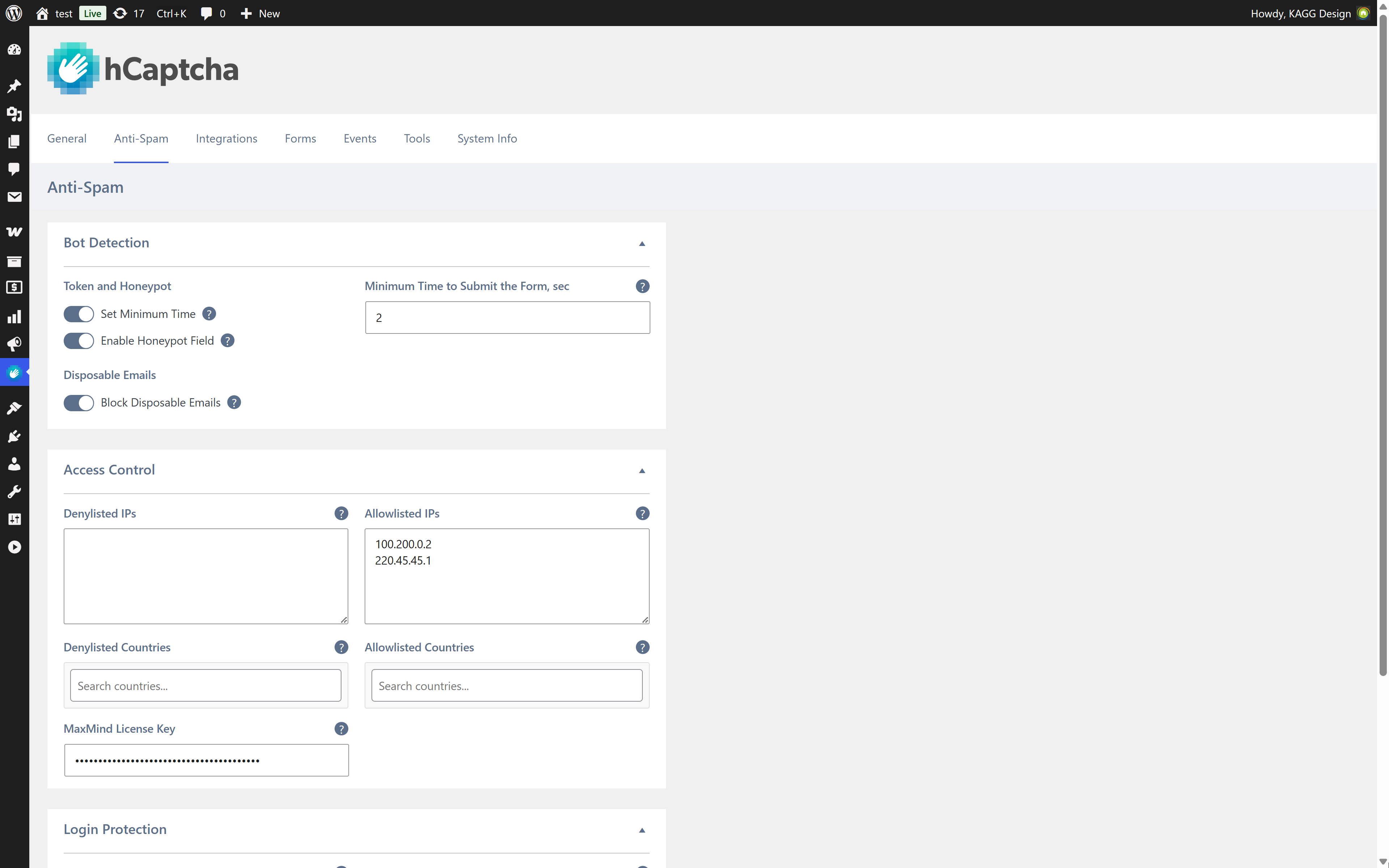
hCaptcha uses REMOTE_ADDR by default. If your site is behind a trusted proxy or CDN, go to Settings → hCaptcha → Anti-Spam → Access Control and select only the IP headers your edge service overwrites or strips from direct client requests.
Forwarding headers such as X-Forwarded-For, CF-Connecting-IP, and X-Real-IP can be spoofed when they pass through from the browser unchanged. Do not enable a header unless your hosting stack makes it trustworthy before WordPress receives the request.
On upgrade, custom hcap_trusted_address_headers filters are migrated into this setting. Otherwise the setting starts empty and an admin notice asks you to review it.
How to allowlist certain IPs
You can use the following filter. It should be added to your plugin’s (or mu-plugin’s) main file. This filter won’t work being added to a theme’s functions.php file.
/**
 * Filter user IP to check if it is allowlisted.
 * For allowlisted IPs, hCaptcha will not be shown.
 *
 * @param bool|mixed $allowlisted Whether IP is allowlisted.
 * @param string     $ip          IP.
 *
 * @return bool
 */
function my_hcap_allowlist_ip( $allowlisted, $ip ): bool {
  $allowlisted = (bool) $allowlisted;

  // Allowlist local IPs.
  if ( false === $ip ) {
    return true;
  }

  // Allowlist some other IPs.
  if ( '1.1.1.1' === $ip ) {
    return true;
  }

  return $allowlisted;
}

add_filter( 'hcap_whitelist_ip', 'my_hcap_allowlist_ip', 10, 2 );
How do I change the appearance of the admin menu?
Starting from 4.1.0, the admin menu was moved to the top level with subpages.
You can customize this by returning it to the previous location in the admin Settings section or tweaking its appearance.
To do this, use the following filter to your plugin’s (or mu-plugin’s) main file. This code won’t work being added to a theme’s functions.php file.
/**
 * Filter the settings system initialization arguments.
 *
 * @param array|mixed $args Settings system initialization arguments.
 */
function hcap_settings_init_args_filter( $args ): array {
  $args = (array) $args;

  $args['mode'] = 'tabs';

  return $args;
}

add_filter( 'hcap_settings_init_args', 'hcap_settings_init_args_filter' );


$args array has the following fields:

mode: 'pages' or 'tabs' (default 'pages') — the appearance of the admin menu;
parent: a string — the parent menu item. Default '' for 'pages' mode and 'options-general.php' for 'tabs' mode;
position: a number — the position of the menu item. Default 58.990225 for 'pages' mode. It Has no effect on 'tabs' mode;
Where do I report security bugs found in this plugin?
Please report security vulnerabilities by email to:
security@hcaptcha.com
When reporting a vulnerability, please include as much information as possible to help us reproduce and investigate the issue, such as:
- A clear description of the vulnerability
- Steps to reproduce
- Proof-of-concept or exploit code (if available)
- Affected versions
We will review your report and respond as quickly as possible.
Where can I get more information about hCaptcha?
Please see our website.
How can I rerun the setup wizard?
Use the plugin-generated “Restart wizard” onboarding link from the admin area. Onboarding setup URLs are nonce-protected and should not be crafted manually.