
Customize your WordPress login page and provide a sophisticated frontend dashboard for your users with Brand Master.
Brand Master is a powerful plugin designed to provide you complete control over the appearance and behaviour of your WordPress login pages, along with a seamless experience for users through a customized frontend dashboard. Elevate your brand by creating a unique and user-friendly login and frontend dashboard environment.
Available shortcodes
- [brand_master_dashboard /]
- [brand_master_login /]
Inbuilt Patterns for Quick Setup
The ‘Brand Master’ plugin comes with a collection of inbuilt Gutenberg Block Patterns that users can easily apply for a quick setup. It includes patters for dashboard main page and support page.
Locating and Inserting Patterns
-
Access the Block Editor: Open the page or post where you want to use a pattern. Click the “Add Block” button (+) or the “+” sign in the top left corner of the block editor.
-
Switch to the Patterns Tab: In the block inserter window, click the “Patterns” tab. This displays all available patterns.
-
Dashboard : Within the Patterns tab, find the category labeled “Dashboard.” This categorization ensures a quick and efficient search for the patterns tailored to your needs.
-
Insert a Pattern: Click on one of the pattern to insert it directly into your edit content area.
-
Modify as Needed: The inserted pattern serves as a starter template. Customize it effortlessly to align with your specific requirements. Modify text, colors, and any other elements to ensure your Dashboard page reflects your unique style.
Features
-
Login Page Customization:
- Personalize the login, registration, and password reset pages with your brand colors, logo, and background images.
-
Frontend Dashboard:
- Integrate a stylish frontend dashboard for users with customizable dashboard and menu content from selected pages.
-
Branding Options:
- Customize the WordPress logo on the login page and dashboard, reinforcing your brand identity.
-
Responsive Design:
- Ensure a consistent and responsive design across devices, providing a seamless experience for users on both desktop and mobile.
-
Additional Features:
- Display login user info with avatar, advanced menu options with menu title, slug, and page selection, social links with headings, and a logout link.
There are two ways to install the plugin:
- Upload the plugin’s zip file via Dashboard -> Plugins -> Add New -> “Upload Plugin”.
- Extract the plugin folder and place it in the “/wp-content/plugins/” directory.
After installation, activate the plugin through the ‘Plugins’ menu in WordPress.
Screenshots
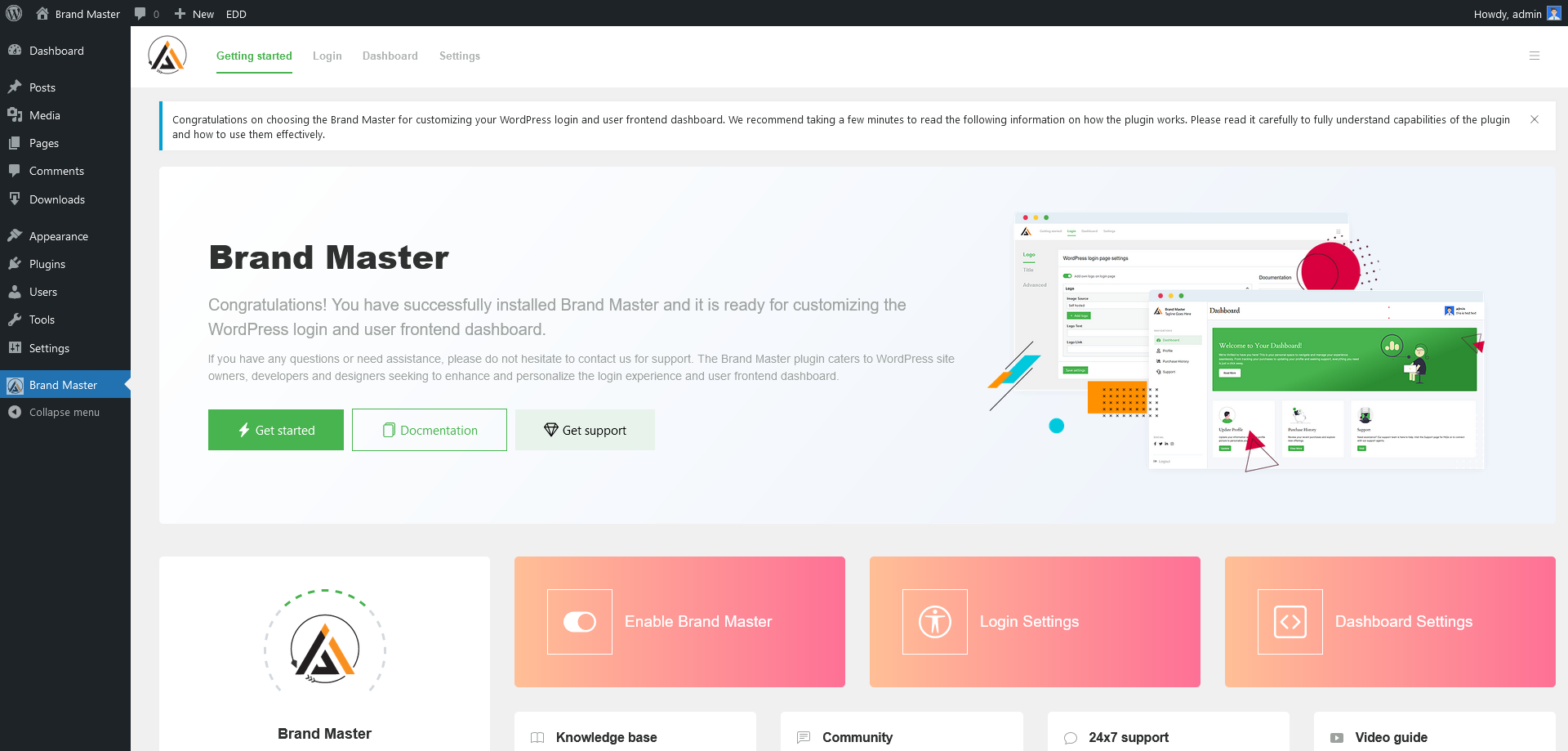
Dashboard - Getting started
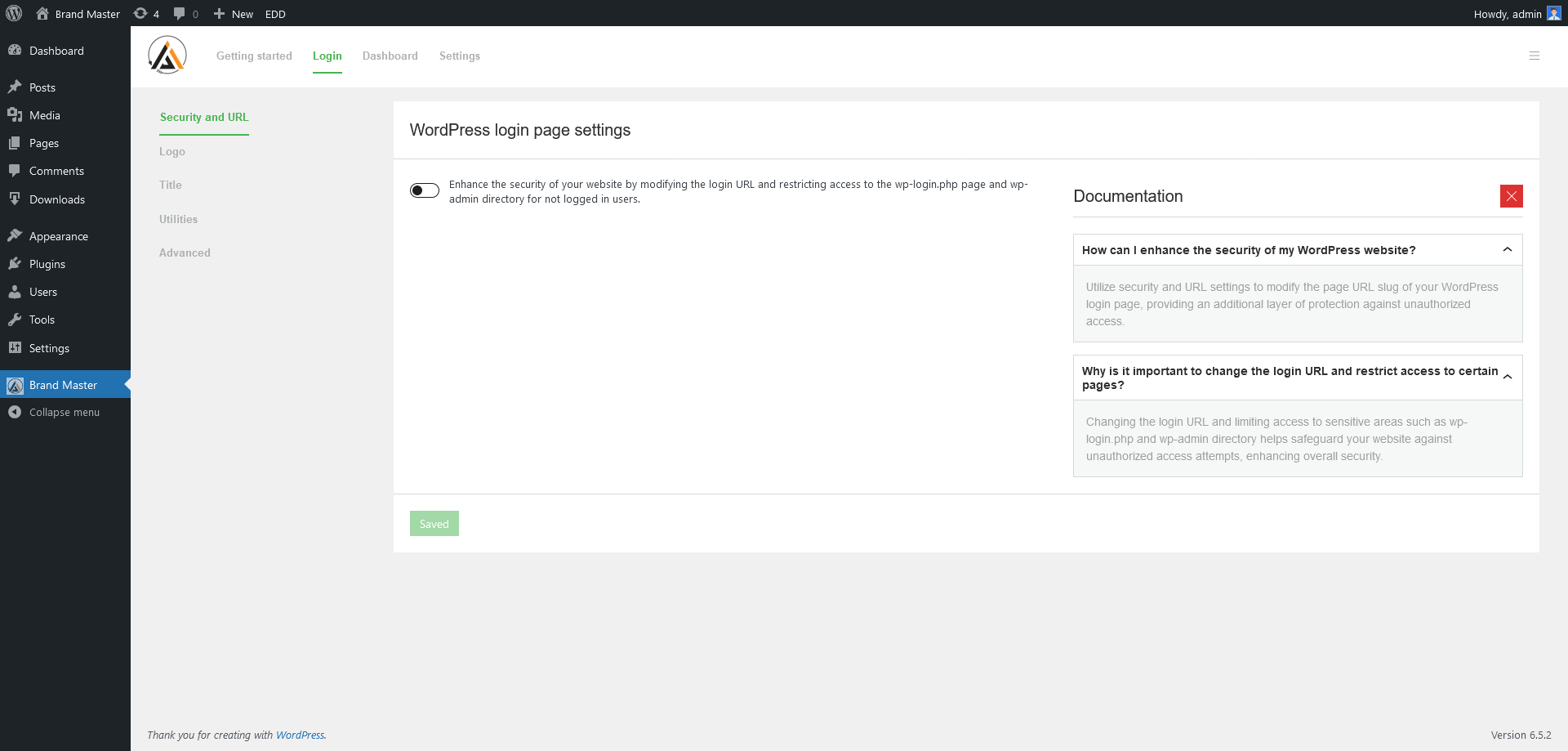
Dashboard - Login Settings => Security and URL
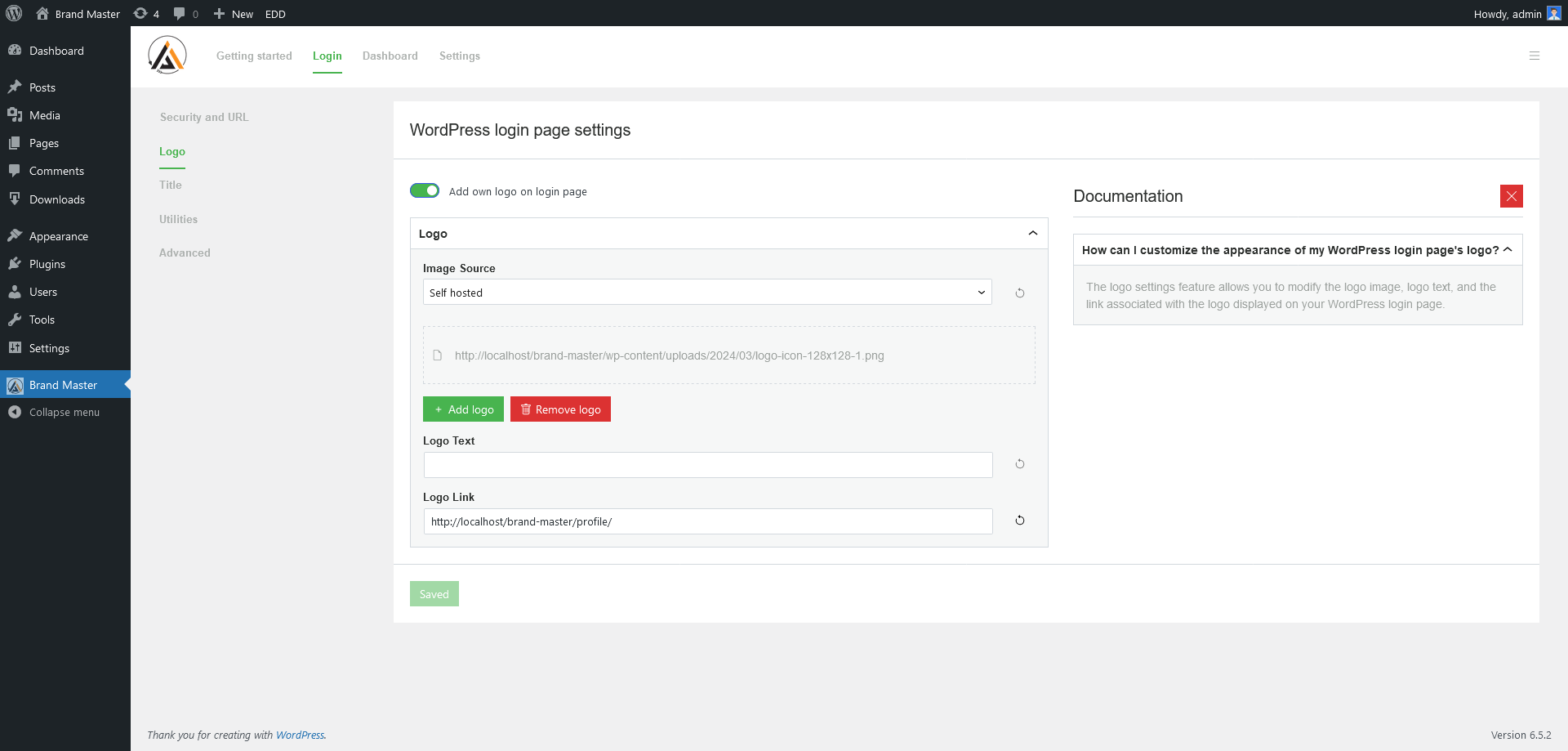
Dashboard - Login Settings => Logo
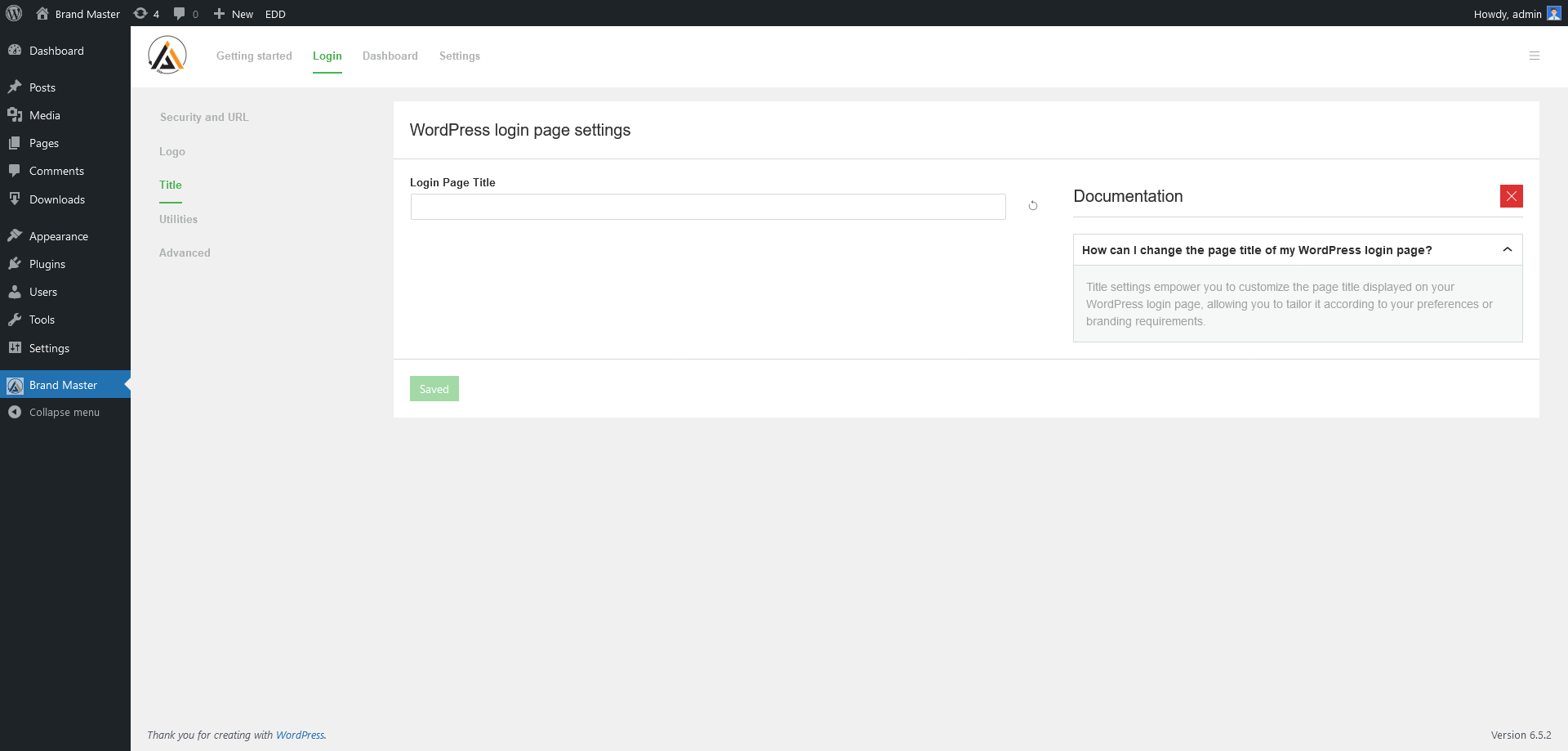
Dashboard - Login Settings => Page Title
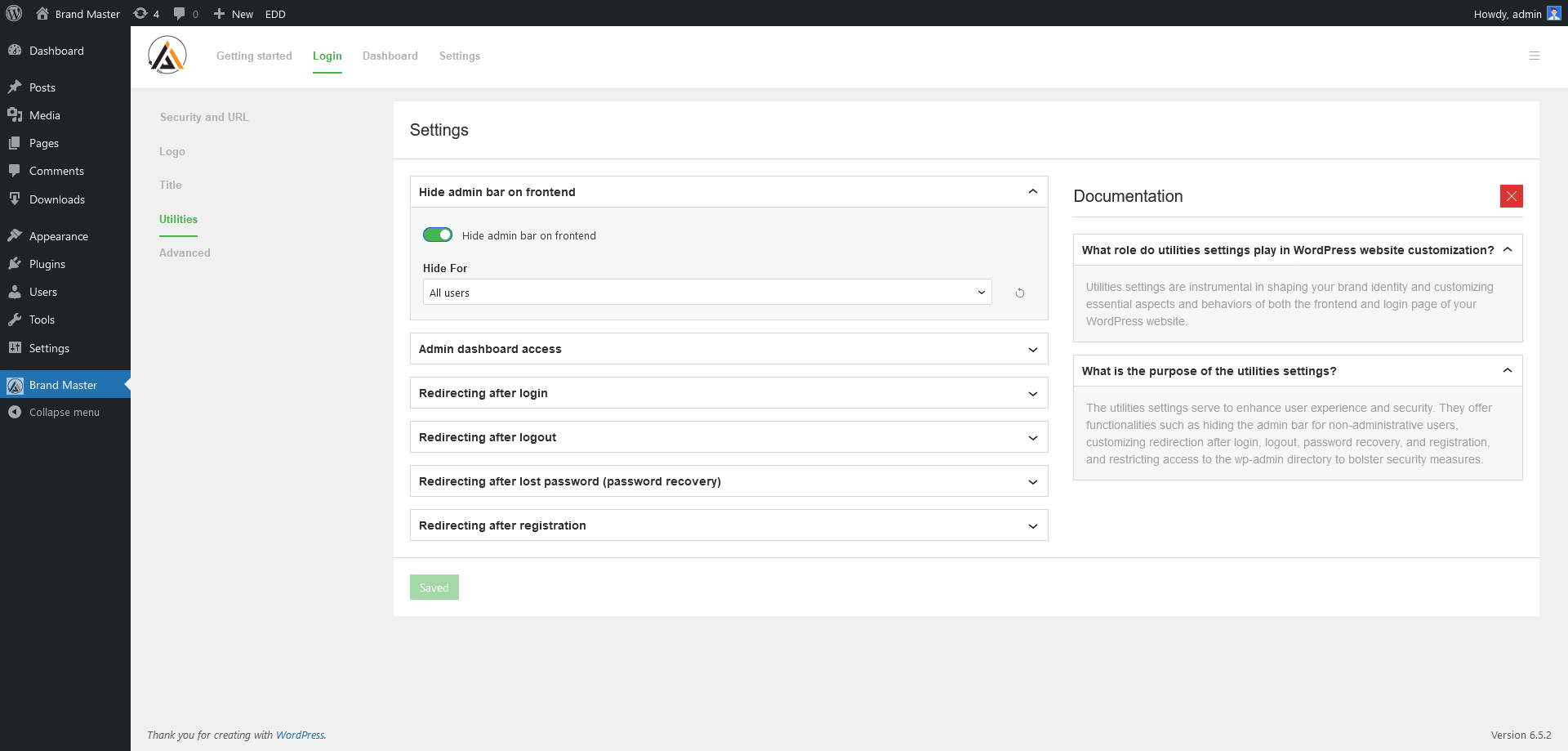
Dashboard - Login Settings => Utilities
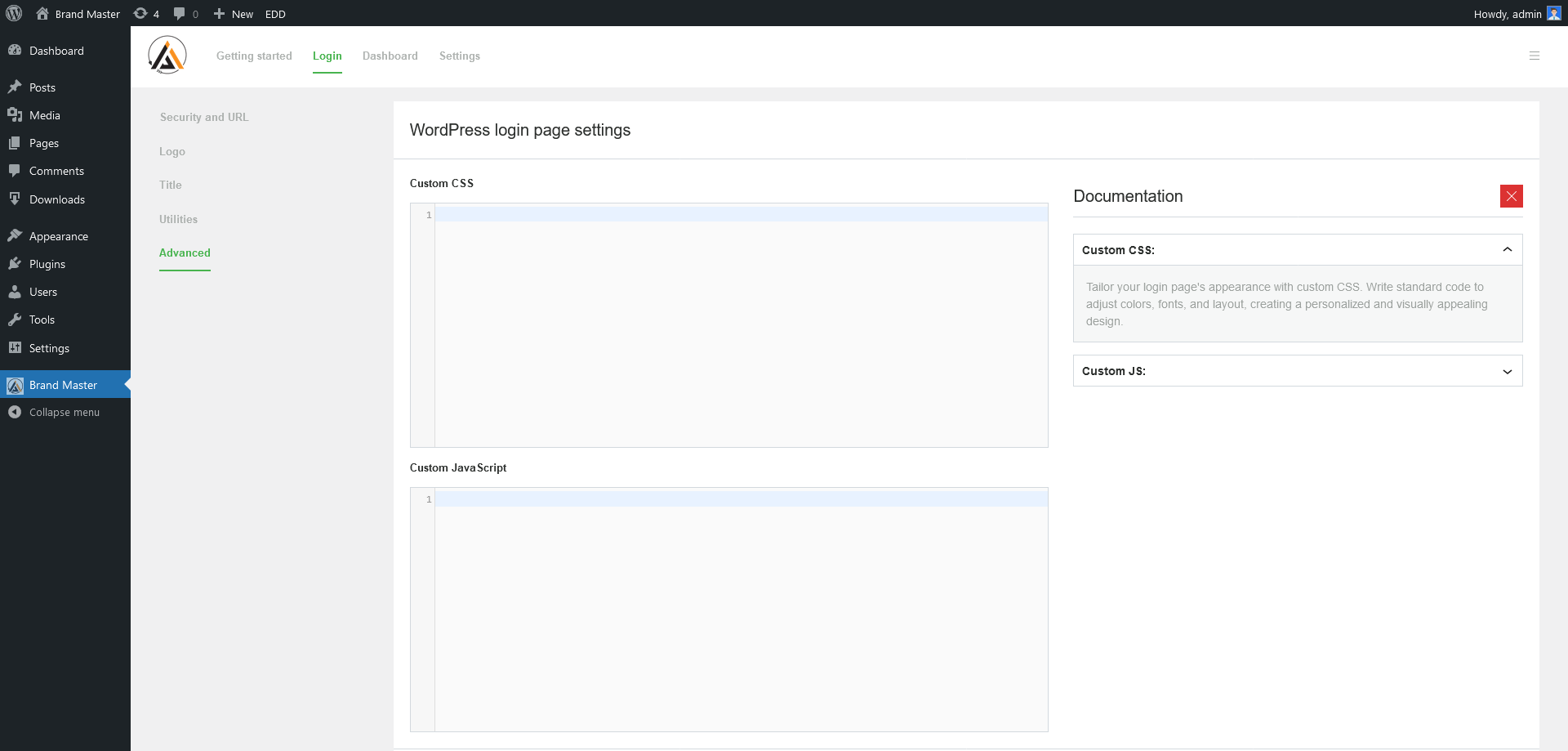
Dashboard - Login Settings => Advanced

Dashboard - Frontend Dashboard Settings => Non-logged-in visitor page
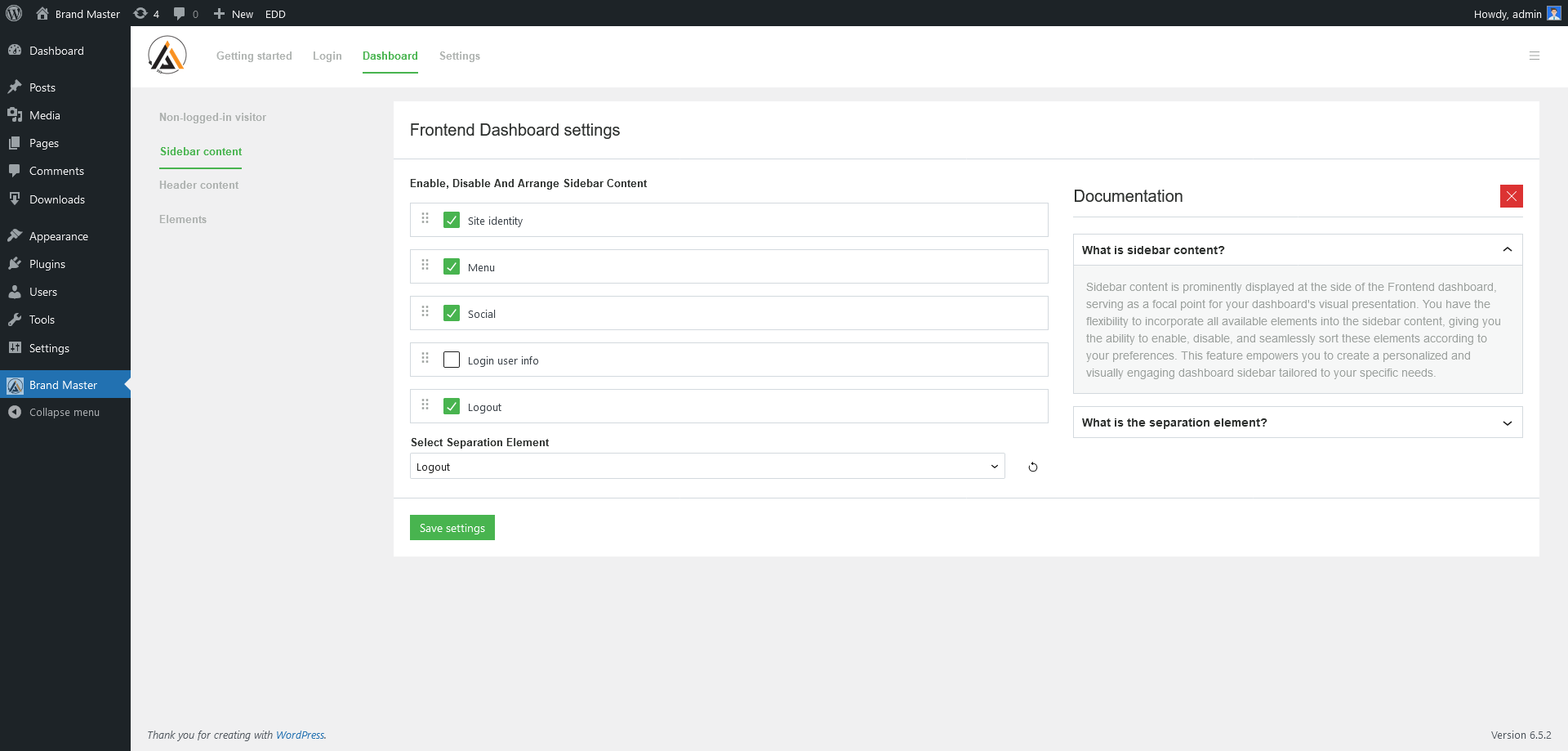
Dashboard - Frontend Dashboard => Sidebar content
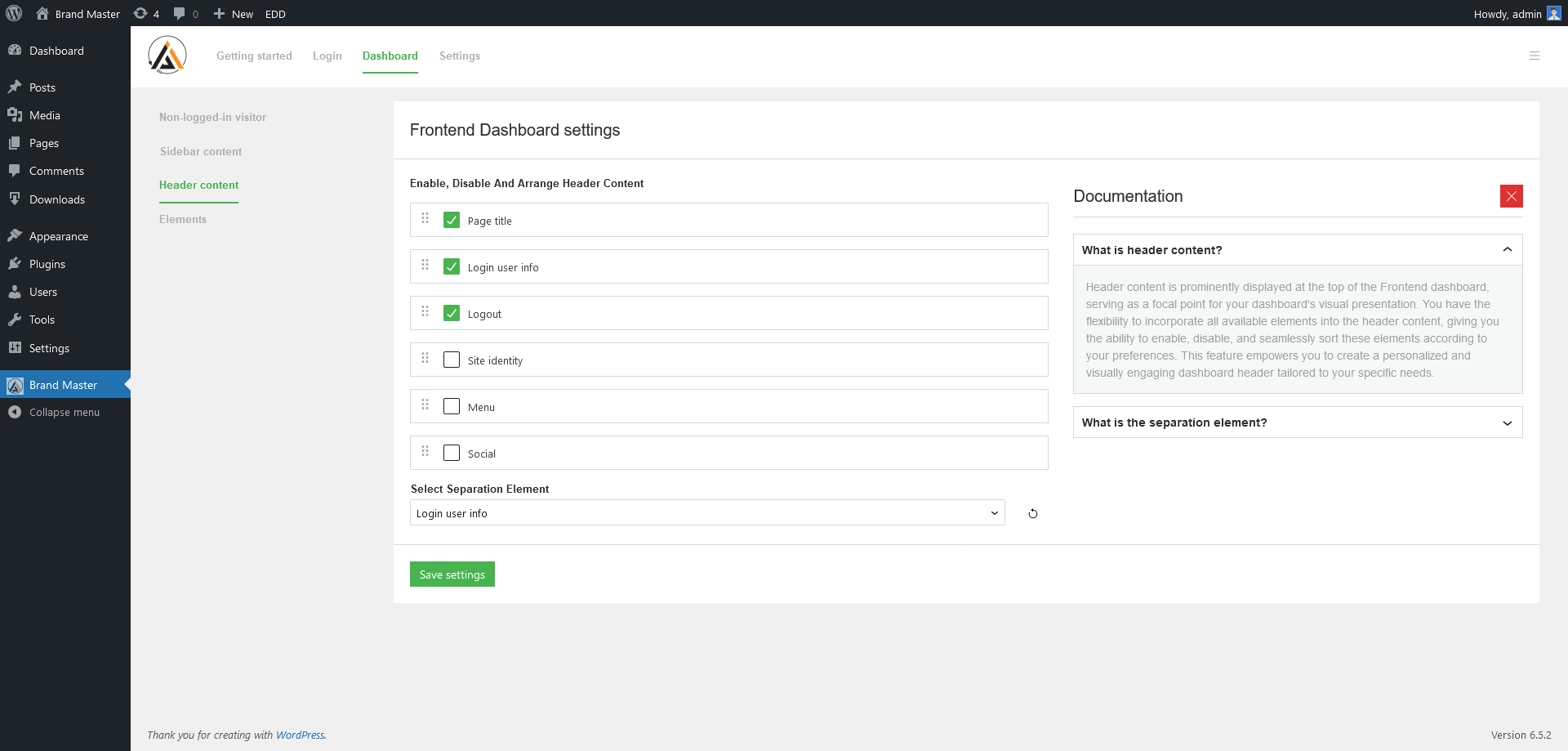
Dashboard - Frontend Dashboard => Header content
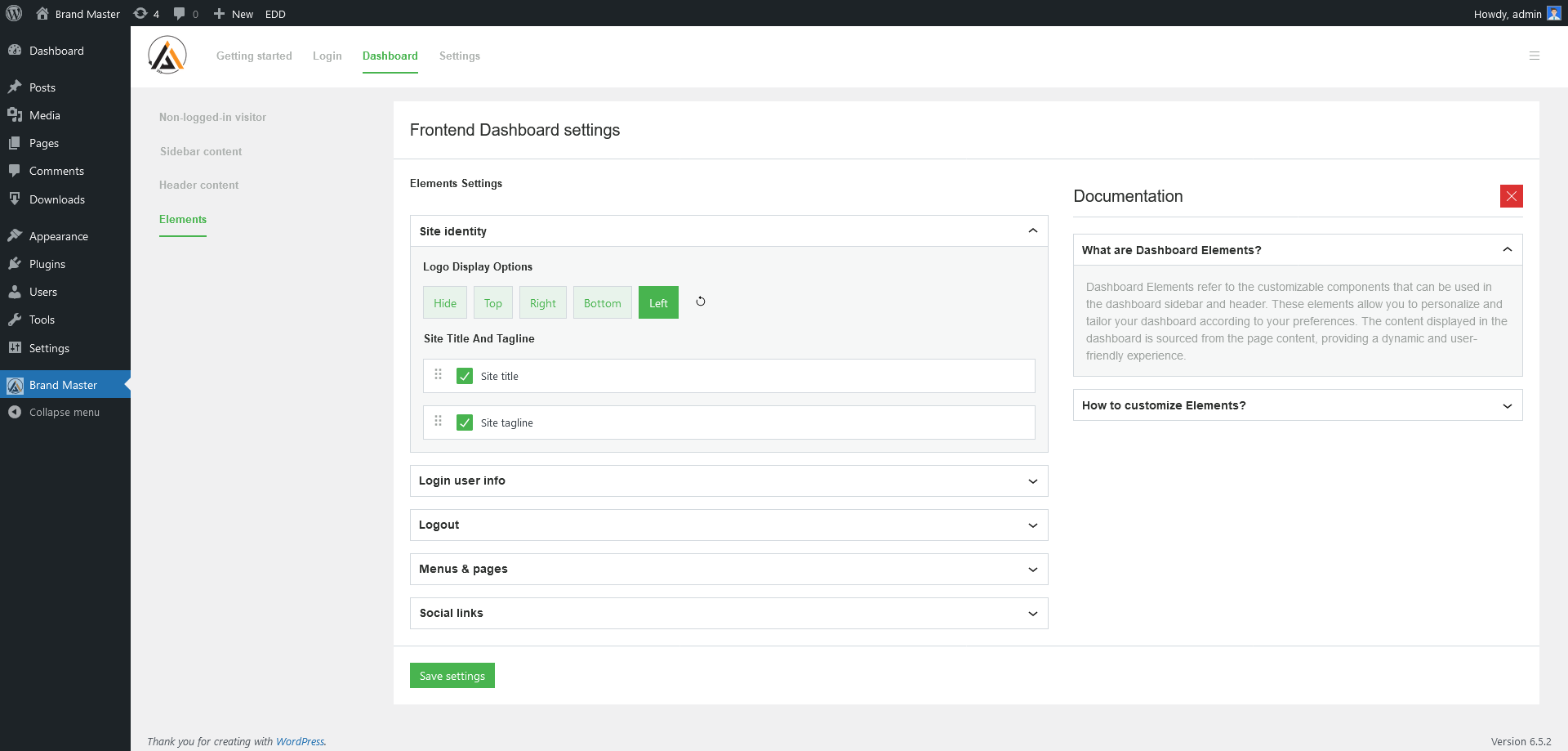
Dashboard - Frontend Dashboard => Elements
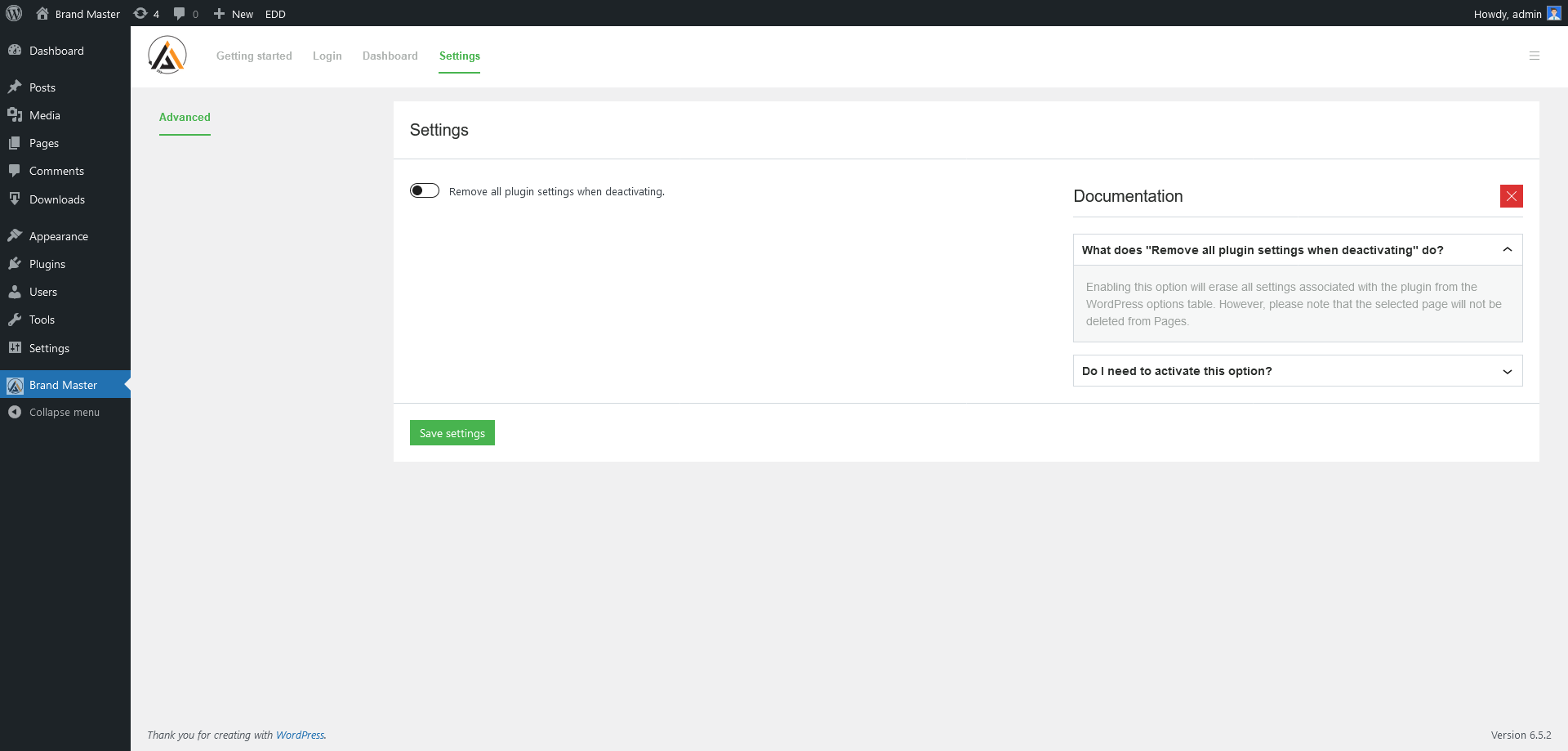
Dashboard - Settings => Advanced
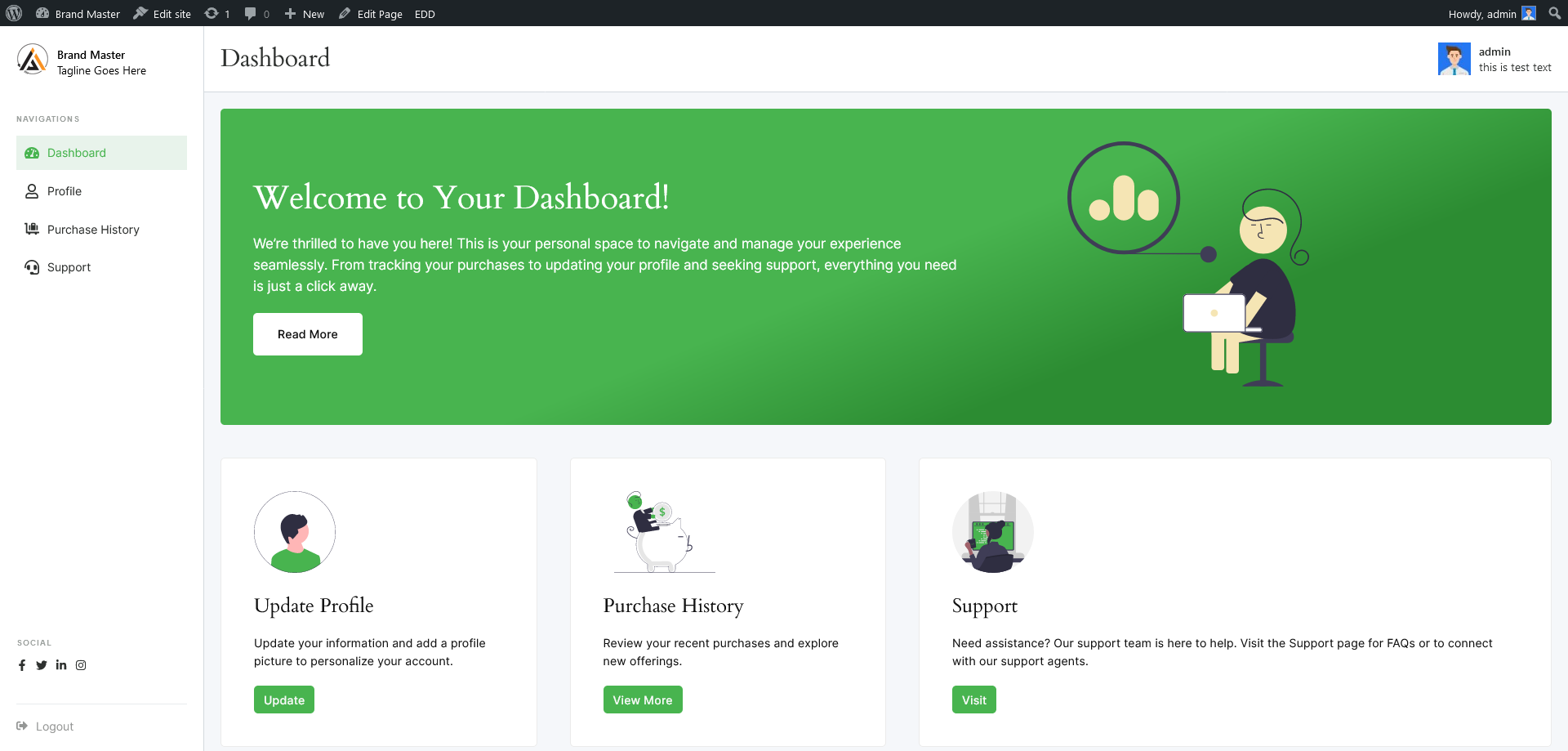
Frontend - User Dashboard
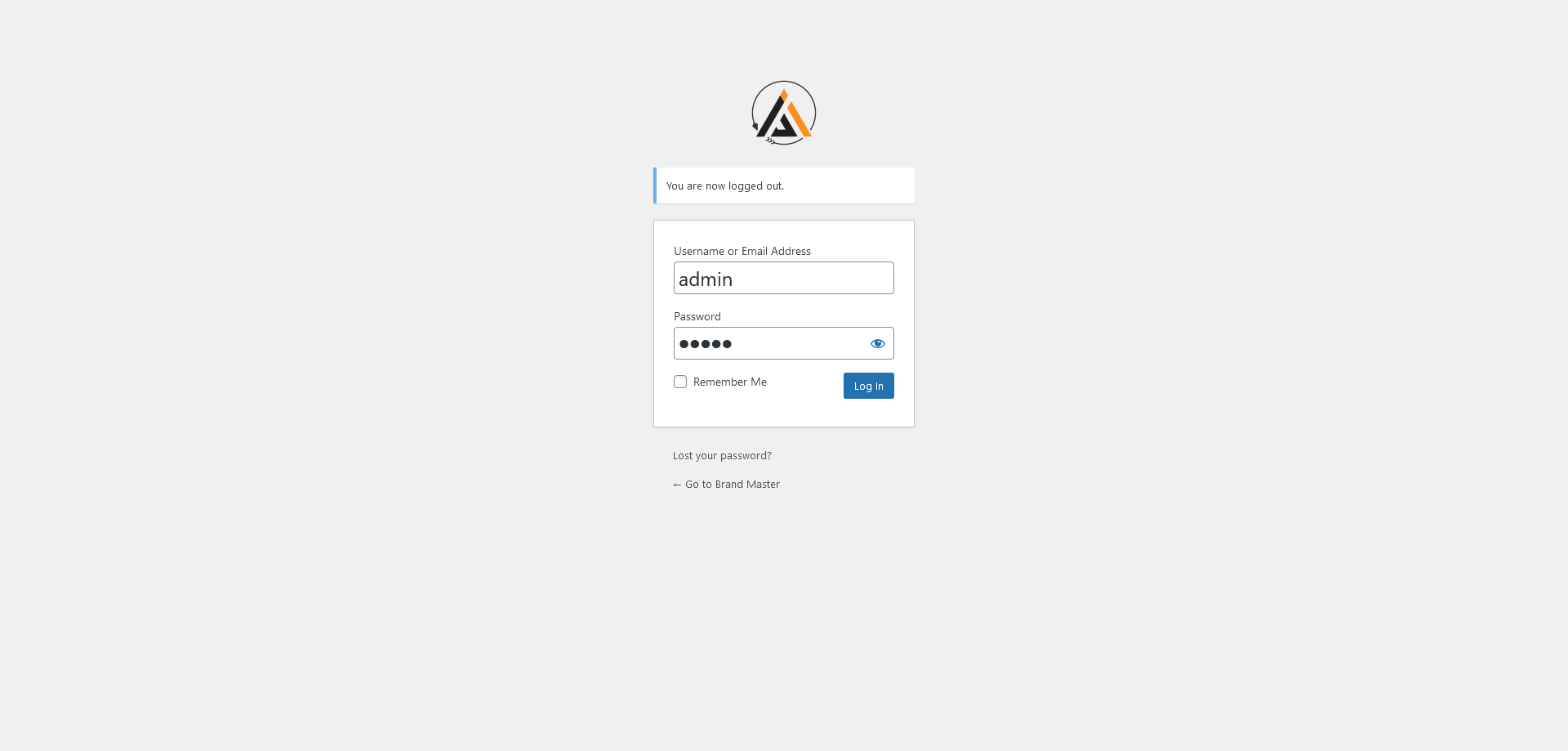
Frontend - Login page with own logo
How can I customize the login pages?
Navigate to the Brand Master settings page in the WordPress admin panel. Here, you can easily customize the login, registration, and password reset pages with your brand elements.
What options are available for the frontend dashboard?
The frontend dashboard offers user info with user avatar, advanced menu options with menu title, slug, and page selection, social links with headings, and a logout link. You can configure these options in the Brand Master settings.
Can I add my own branding elements?
Yes, you can upload your brand logo, set brand colors, and customize various elements to align with your brand identity.
Does this change the WordPress backend dashboard?
No, Brand Master does not alter the WordPress backend dashboard. It facilitates the creation of a customized frontend dashboard for users while keeping the backend dashboard unchanged.
Does this work on multisite?
Yes. Settings are stored per site. Network administrators can reach each site’s Brand Master settings (the settings page and REST endpoint accept network admins in addition to per-site admins). Uninstalling removes the current site’s settings; a network-wide uninstall cleans each site in turn.
ChangeLog
1.0.6
- Added: Tested up to WordPress 7.1
- Fixed: Removed the duplicate Tested up to plugin header for WordPress.org compatibility
- Changed: Raised minimum PHP requirement to 8.3
- Changed: Raised minimum WordPress requirement to 7.0 and confirmed compatibility with WordPress 7.0 and 7.1
- Changed: Modernized Sass modules and lazy-loaded admin routes to reduce the initial admin bundle
- Added: Deep recursive settings sanitization with unfiltered_html gate for custom CSS/JS
- Added: Login/redirect slug conflict validation (reserved slugs, page collisions)
- Added: uninstall.php for clean data deletion
- Added: PHPUnit test suite and GitHub Actions CI
- Added: WordPress 7.0/7.1 runtime smoke tests and reproducible release artifacts
- Security: SVN publishing requires a validated release tag and the exact digest-reviewed package
- Security: Redirect URL validation via wp_validate_redirect (internal-only by default)
- Security: Closed /wp/v2/settings REST endpoint exposure
- Fix: Scoped site_url filter to wp-login.php paths only
- Fix: Social link target/rel attributes use whitelist-built values
- Accessibility: aria-current on active menu item; heading hierarchy fix
- i18n: Default labels translated at render time
- Security: Partial settings updates now deep-merge instead of overwriting the whole options row (no more silent sibling-data loss via the REST API)
- Security: Login-page CSS/JS render output neutralizes tag breakouts even if a stored value bypasses sanitization
- Fix: Legacy login globals ($error, $user_login) are only initialized when unset, preserving prior-handler values on lost-password/reset/registration flows
- Fix: Settings page and REST endpoint accept network admins on network-active multisite installs
- Fix: dashboard.userInfo.sort schema corrected; siteIdentity/userInfo logo fields constrained to their valid values
- Fix: Custom login slug no longer emits “Undefined variable $user_login / $error” warnings — wp-login.php globals are now bound in the including method scope (version-agnostic across WP 6.6/6.7/7.x)
- Fix: Custom login slug responses now return HTTP 200 instead of retaining a 404 status
- Fix: wp-login.php redirect allowlist — logout, password-reset key exchange (rp/resetpass) and all POST requests pass through instead of bouncing to the redirect slug
- Fix: Custom login slug matching is now exact-path (tails like /ogin no longer load the login page); referer handling hardened for missing Referer headers
- Added: Unit coverage for login scope binding, wp-login.php redirect matrix, exact slug matching, and admin-bar / post-action redirect settings
- Added: Automated WordPress.org deployment from published GitHub Releases
- Added: Public source code and build documentation

